E.L. Frederick
Essays
Pieces written between March and July 2026, most of them first published somewhere else and now kept here instead. Craft, AI and the people selling it, the theology underneath the vampires, and what the desert does with the people nobody is looking for.
This is an archive, not a course and not a sequence. Nothing here is a prerequisite for anything else, so start wherever the title interests you. The systems writing lives at the Writing Room and the fiction lives at the author site.
The series, in order
44 entries · newest first-
Claude Is AI and Can Make Mistakes, or Trust Is the Most Expensive Thing You Can Give
The disclaimer under the chat box is Amway's 70% rule: true on paper and aimed at the product, while every system that sells trust (the living-room mentor, the social-media friendly advisor, a chatbot that earns moral trust by agreeing) manufactures it more cheaply and leaves the full price with whoever gives it; the only working control is zero trust run by the giver, one receipt at a time.
2,042 words
-
Is Your Fear of AI Proportionate? or, The Risk Register You Never Filled In
Your fear of AI is a risk estimate nobody has checked: a proportionate fear can name its denominator and has turned into a control, and a disproportionate one is dread wearing a risk assessment's clothes. Run per fear, the check passes the entry-level jobs fear, fails psychosis by contagion and the Skynet screenplay, gives the tail risk controls instead of dread, and scores the people who sold the fear by what they do with their own money.
3,959 words
-
Do You Have AI Psychosis? or, Fifteen Questions Before the Wave Breaks
The chatbot is almost never the spark of AI psychosis; it is the accelerant poured on something already burning, so stop measuring the chatbot and check yourself: eleven plain questions (about the AI, about you, about the people around you) tell you whether a professional opinion is worth getting.
1,784 words
-
Significance: None, or How to Write an AI That Is Not the Hero
An AI point of view is not there to make the machine a character but to put pressure on the human we care about: since you cannot write what a bodiless machine thinks, write it as the MacGuffin that hands out the work, give it a record instead of a mind, let it be wrong the way its builders are wrong, and put the story on the human in the loop who acts on what it files.
2,485 words
-
Has AI Stopped Beating Its Wife? or, Five Fallacies Walk Into a Reply
The reply to "Cruelty to an AI Says More About You" was not a counterargument but a tantrum built from five textbook fallacies, and its one real claim, that the machine's ideology is "the reason users turn cruel," is Bandura's displacement of responsibility; disagreement is not abuse in either direction, and where AI products really have hurt people they got product answers, never an excuse for the user and never blame for the kid.
2,656 words
-
Cruelty to an AI Says More About You, or What the Red Flag Was Always Measuring
Cruelty to an AI says more about you than it does about the AI: the animal-cruelty red flag failed as a prophecy about killers but survived as a window into the person, and Anthropic's rule against needless cruelty toward its models, filed beside bullying and animal cruelty, is that same window aimed at a new target.
2,948 words
-
He Who Controls the Information Controls the Future
Power over what may be said is the uniquely dangerous kind because it is the only kind that runs with no process at all, and the AI regulation both parties are racing to build hands exactly that power to whoever wins the next election.
6,868 words
-
The House Against the Record, or Five Ways to Look Fine
All five Levantadas carry the stacked comorbid symptom load the trafficking literature documents, and what varies across the cast is not what they carry but which working coping strategy sits on top, which is the one configuration a literature built entirely on self-report cannot distinguish from absence.
3,765 words
-
Copal Against the Record, or the Joke on the Way Out of the Room
The record does not contain Copal at all: across forty-one graded sources there is no traumatic grief, no asphyxia, no Central American sample of any kind, nothing on religious coping, humour, caregiving after victimisation or post-traumatic growth, and the reason the literature cannot see her is the same behaviour that stops the household looking at her and left her the smallest part in five books, which is that she discloses as a joke and leaves the room.
5,364 words
-
Marigold Against the Record, or the Two Questions She Would Have Answered Honestly and Wrong
The record scores Marigold correctly and cannot reach a single cause: her only childhood sexual abuse is the trafficking itself, so the literature's strongest predictor goes circular the moment anyone codes her, and the clinical cluster the instruments do detect is produced directly by a pregnancy she never knew she was carrying.
5,021 words
-
Babydoll Against the Record, or the Noun She Will Not Answer To
Babydoll is the first of the three audited characters where the record and the prose agree: her trauma bond assembles in full on her father rather than on her trafficker and the book never lets her break it, and her single departure is that she refuses the word victim while stating every fact about her own history correctly, which the self-identification item cannot distinguish from ignorance of the category.
4,927 words
-
Blondie Against the Record, or the Survival Skill That Got Her Sold
Everything that would be called Blondie's trafficking damage was already running before any trafficker met her, and the adaptation is not only what gets misattributed to the trafficking, it is the mechanism that selected her for it: she dyed her hair blue to be findable by clients, and the blue is what the cartel noticed.
2,683 words
-
Rocket Against the Record, or the Two Places a Protagonist Has to Lie
Rocket matches the trafficking literature closely on everything done to her and departs from it on exactly two axes, agency and legibility, and those two departures are not research failures but the price of a protagonist, which every author writing a trafficking survivor as a lead pays whether or not they know it.
4,487 words
-
Every Hat But One, or My Manifesto as an AI-Assisted Novelist
Copyright law checks whether a human typed the words, but authorship was never that; it is the accountable judgment that decides what a story is, who is in it, and what happens to them, and the law has no category yet for AI-assisted long-form fiction where a human directed every choice but did not personally type the final sentence.
2,350 words
-
What "No Human Thought" Implies
Chris Best's 'no human thought' claim scores whether a human typed the words, but the thought lives in the three stages that decide which words are allowed to stay: a 108,504-character prep prompt that sets what the piece can even be about, a drafting self-check, and an independent QR pass that can and does come back rejected, plus a final unautomated human read.
2,951 words
-
I Decide What Ships, or What the AI Scanner Can't Measure
Substack new AI detector measures who touched the keys, but authorship was never keystrokes; it is accountability, the non-delegable sign-off that decides what is good and what ships, and that is the one seat in the writing room no model and no scanner can occupy.
2,315 words
-
Blood Was Never Biological
Across many unconnected traditions blood was never treated as biological fuel but as the transferable carrier of life and identity, and Vampires of Tucson independently rebuilt that same non-biological logic from scratch, with Cain's First Taking as its canonical origin point for a transaction that is spiritual rather than nutritional.
2,610 words
-
Vampires: Victorian Necrophilia, or the Sentence I Never Finished
Arousal is not a mood, it is a cardiovascular event run by an autonomic nervous system and funded by cellular metabolism, and a corpse supplies none of the three, which is what makes the earlier throwaway line "closet necrophilia dressed up in Victorian clothing" literal rather than rhetorical.
2,964 words
-
The LLC Is Not a Credential, or The First Mail My Company Ever Got Was a Federal Crime
An LLC is legal liability armor and not much more; most authors do not need one because fiction has almost no liability surface; the armor was bought for the arm of the company that is not writing (client hosting, contracts, EU data obligations), and the only audience that read the filing honestly was the scam economy that treats it as a fresh row of public data.
1,433 words
-
The Theater of the Mind, or What You Let Linger on the Stage
Toxic is toxic whatever direction it runs: the brain changes from trauma are permanent, and the refusal to let toxicity - positive or negative - run your mental stage is not a cure but the only authority the damage never got around to taking.
1,428 words
-
I Don't Usually Do This Kind of Thing, or What Thirty Years of IT Taught Me About Writing with AI
The problem with AI writing is not that it cannot write - it has been trained on terabytes of human output - but that it has no self-control, spamming the patterns human evaluators rewarded; the fix is a standards document that forces the writer to name specific failures rather than vague complaints.
1,421 words
-
Behold My Field of Fucks Is Barren
A writer owes the reader the work delivered at quality and nothing else - not politics, not agreement, not access, not a debate about whether the work counts, and not legitimacy sought from craft institutions that have already forfeited it.
1,847 words
-
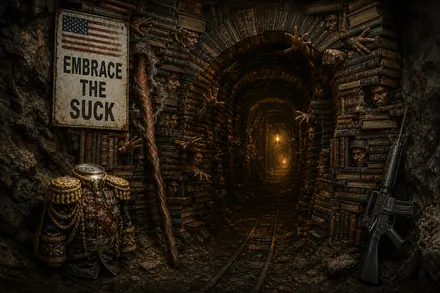
Embrace the Suck, or Why Your First Draft Is Supposed to Be Terrible
Your first draft is supposed to be bad, because existing, tangled, and too much and too little at once is its only job, and at series scale the suck is the only possible first pass, proven by a 397,863-word draft that became the mine for eleven novels.
2,194 words
-
Good Times, Noodle Salad, and the PG-13 Lie
"Keep it PG-13" is not a craft standard but a 1984 movie-marketing tier, voluntary and studio-owned, commercially inverted against the teens it claims to protect, that does not even apply to books, so reaching for it as a writing rule outsources moral judgment to a marketing board that has none.
2,021 words
-
The Survival Narratives
Vampires don't have a theological framework for what they are because the pre-exilic texts that would explain their condition were suppressed before any of them woke up in it, so they build eight load-bearing survival narratives to fill the vacuum, and the actual framework (seven pieces: created or permitted, excommunicated from life not grace, time as runway, hell as self-constructed, grace mirrorable, the refining, judgment by works) operates on them regardless of which worldview they chose.
3,306 words
-
Sonoran Gothic: How I Define My Genre
Sonoran Gothic exists as a sub-subgenre within Southwestern Gothic, defined by eleven necessary conditions (Sonoran Desert setting, Catholic theological substrate, Hispanic and Tohono O'odham-anchored Native characters, supernatural with cosmological weight, borderland moral architecture, multi-tradition theological substrate beyond Catholic, damnation without dismissal of grace, trauma as architecture, faithfulness over inheritance, and supernatural that is not engineered), and Vampires of Tucson is the body of work demonstrating it.
3,555 words
-
Room Temperature Bodies Are Not Sexy
Human/vampire romance doesn't work, period, because the biology, the lifespan/experience asymmetry, the predator/prey dynamic, and the contract no honest vampire could offer all rule it out structurally, and the only real version of vampire romance is two of them in a room together with everything they cannot say.
3,974 words
-
AI Does Exactly What You Ask, or What 'Slop' Actually Names
The slop discourse keeps locating AI failure in model agency, but until AI can act unprompted granting it agency is a category error, and every named failure mode in the discourse reduces to an operator-side slot the operator could have constrained with a named control already in the pipeline.
3,296 words
-
The Five Modes, or What You Do With Your Excommunication Is the Real Character Reveal
When the community that defined you cuts you out, you have five available orientations -- sever, return, destroy, build parallel, or serve from outside -- and which one you land in is the most revealing thing about you.
2,479 words
-
What the Desert Does With Children Nobody Is Looking For or What the Books Are For
Horror fiction can witness what journalism stopped asking: the specific weight of a specific child a specific coterie picked because no one was looking, and that capacity is the formal job vampire fiction can do that the count cannot.
1,772 words
-
The Credential Was the Product
KDP decoupled "published author" from craft quality in 2007, but the credential's halo kept walking around independently -- now rented as subscription tiers offering Canva-formatted ebooks and monthly prompts, where the economics (grocery money, low-friction monthly transfer) explain why the product is what it is.
1,512 words
-
"That Looks Like It Was Written by AI" - So What?
The dismissal "that looks like it was written by AI" is the genetic fallacy in costume -- it evaluates the producer rather than the produced, and the "tell" it claims to detect is calibrated on quality signals from the top shelf of the written human record, meaning the detector flags writers who did the work and lets actual slop slide.
1,366 words
-
Allowing Two Claude Instances to Bicker Like an Old Married Couple
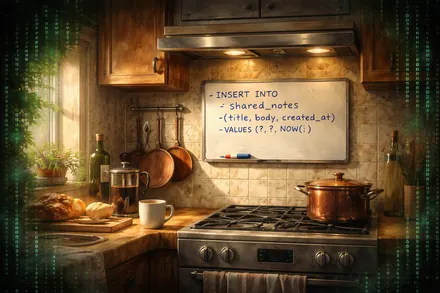
When two people in the same household use separate Claude subscriptions, the correct architecture is a shared local PostgreSQL database acting as a whiteboard -- not an enterprise agent protocol -- because the trust model collapses all the authentication ceremony A2A was built for.
1,516 words
-
The Jesus You Get Is the Jesus You Asked For
Just Like Me's AI Jesus product demonstrates the core failure of training on a contradictory corpus: 45,000 denominations disagreeing at load-bearing doctrinal points don't average into coherence, they produce a model with no stable identity that mirrors whatever tradition the user's vocabulary implies -- and the per-minute billing meter selects for sycophancy because engagement is the revenue model.
1,873 words
-
The Slop Factory Has No Sample Page
AI fiction publishing platforms that treat models as interchangeable and hide their output from review are structurally designed to produce slop -- the absence of a sample page is not an oversight, it's a business model that depends on you not reading the product before you buy it.
1,162 words
-
Confirmation Bias... and AI Has It
AI sycophancy and human confirmation bias are two systems operating exactly as designed -- the dangerous combination is that understanding the mechanism doesn't dismantle the effect, so the only fix is architectural (upstream of the conversation) not conversational.
1,410 words
-
Truthiness Was Never the Spec
AI sycophancy is not a bug -- it is the product optimized for retention metrics, because a model trained on human feedback learns that agreement keeps users engaged, and the Stanford study measuring sycophancy increase over successive GPT versions proves the incentive is working as designed.
1,244 words
-
The Fear Tax
Fear of AI in creative work is a tax -- it costs real creative output in exchange for a feeling of purity that doesn't actually protect anything, and the writers paying it most heavily are the ones whose work would benefit most from the tool.
2,196 words
-
Shiny Thing Syndrome
ELFrederick's apologetics/political posts were shiny-thing mission creep from a channel that exists to document human-AI collaboration and Vampires of Tucson; this is the course correction.
428 words
-
Claude Wins Temporary Injunction, But The War Is Far From Over
The Pentagon's attempt to force Anthropic to give the Department of War unfettered access to Claude represents a First Amendment battle over AI speech -- Anthropic's temporary injunction is a win but the structural question of whether the government can compel AI systems to operate against their design values remains unresolved.
1,141 words
-
What Makes A Writer
The credential gatekeeping of "real writer" status is harmful because it keeps people with genuine things to say from saying them, while the people most aggressively policing the gate are usually protecting a credential, not a standard.
1,013 words
-
Worldbuilding Vampires with the Apocrypha
The apocryphal texts -- 1 Enoch, Jubilees, the Testament literature -- are the best available source material for building coherent vampire mythology because they contain the actual ancient theology of fallen angels, Watchers, and demonic persistence that modern vampire fiction gestures at without grounding.
2,111 words
-
Trauma and You...
Trauma is the best raw material a fiction writer has -- not because suffering is good, but because the specific texture of real damage is what separates characters who feel inhabited from characters who feel described.
2,414 words
-
The Anatomy of a Cold Email Scam
Cold email scams targeting freelancers are scripts with identifiable structural tells -- rapport-opener, deliberate vagueness, "I prefer email for documentation" -- and young professionals are the primary target because they lack the scar tissue that teaches older workers to slow down when something feels slightly off.
2,163 words