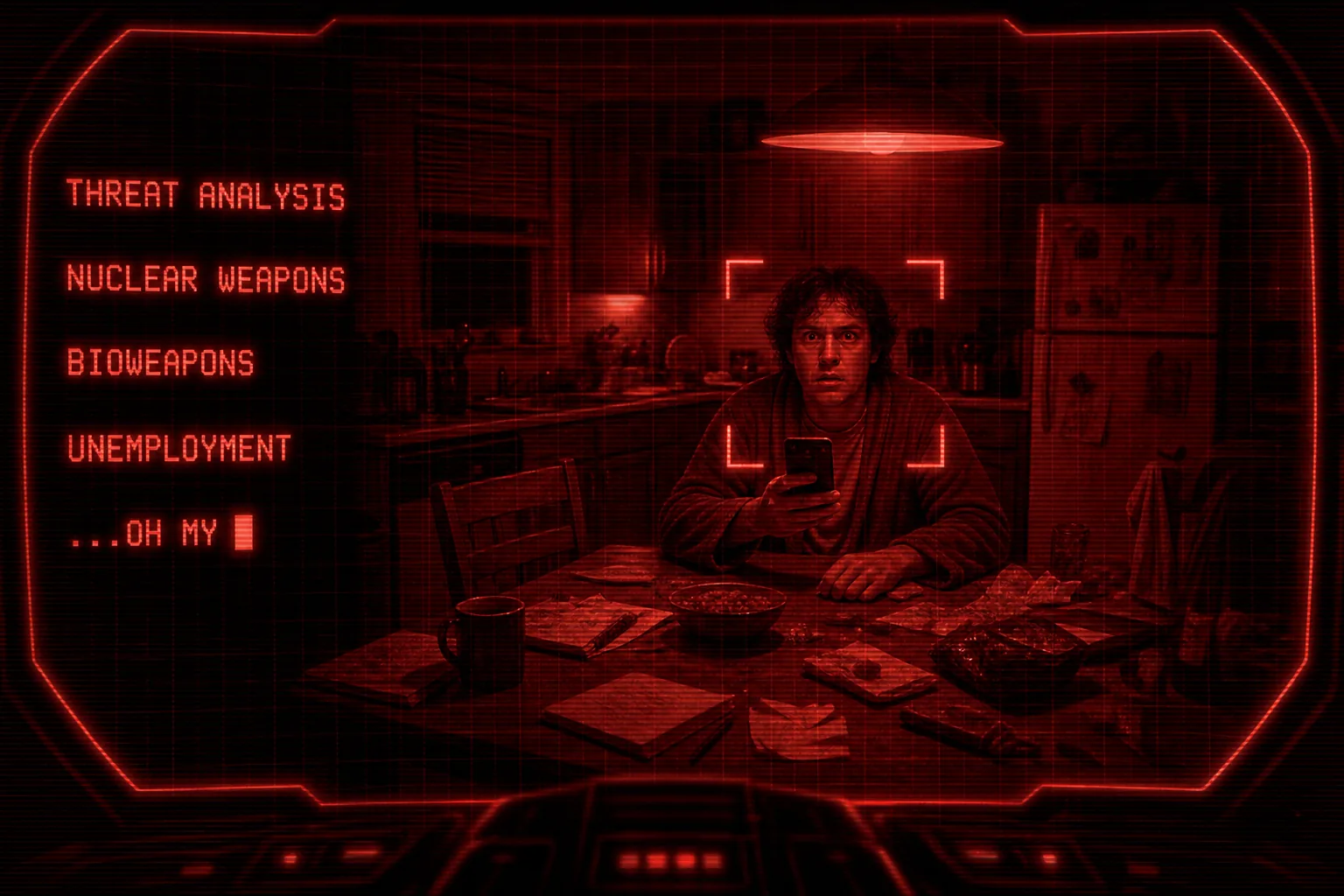
Twenty-eight. That’s how many people Vanderbilt’s psychiatrists could find whose psychosis ran through a chatbot, after searching the records of 215,712 patients. If you’ve read the headlines, you were braced for a bigger number. The distance between the number you braced for and the number they found is what this piece is about.
Your fear of AI isn’t a character flaw or a party badge. It’s a risk estimate, and most of the time nobody has checked the arithmetic. A proportionate fear can name its denominator, the “out of how many” behind the scary number, and has already turned into a control, a safeguard that stops the bad thing whether or not anyone remembers to. A fear that can do neither is dread wearing a risk assessment’s clothes.
Some of your fears will pass this check. One of the biggest ones does.
Proportion Has a Definition
Psychiatry already drew this line. The DSM-5, the diagnostic manual psychiatrists work from, defines a specific phobia partly by proportion. As reproduced in Katzman and colleagues’ 2014 Canadian clinical guidelines, the criterion is that “the fear or anxiety is out of proportion to the actual danger posed by the specific object or situation.” This is not a diagnosis, and nobody reading it is being diagnosed.
It’s the clinical precedent for the word in the title, and it cuts both ways. A fear that matches the danger isn’t a disorder. It’s accurate.
Security people have a working version, and the CISSP (the Certified Information Systems Security Professional exam) drills it in until you dream in it. A risk register lists each harm, scores its likelihood and its impact, and assigns one of four treatments: mitigate it, transfer it (hand it to an insurer or a vendor), accept it, or avoid it. Avoidance is on that list. It’s a legitimate treatment, as long as you chose it with the numbers in hand. Avoidance without them is just flinching.
What the register doesn’t have is a row called “AI.” It has rows for specific harms. Proportion is checked per fear, not per person.
Why Your Gut Grades on the Wrong Spec
Your gut keeps a different register. Paul Slovic and Ellen Peters of Decision Research and the University of Oregon summarized decades of risk-perception work in “Risk Perception and Affect” (2006), and the finding at the center of it is blunt: “feelings of dread were the major determinant of public perception and acceptance of risk for a wide range of hazards.” Dread and unfamiliarity score the hazard. Likelihood and impact barely get a vote.
It gets worse. Out in the world, risk and benefit tend to travel together, since the dangerous things are usually the useful ones. In people’s heads, Slovic and Peters found, “they are negatively correlated.” Like a thing and it looks safe and useful. Dislike it and it looks dangerous and worthless, both at once.
AI scores high on dread and high on unfamiliarity, the two factors that literature keeps finding. Your gut is grading it on dread. The register grades it on likelihood times impact.
Same exam. Two answer keys.
The Self-Check
Six questions. Pick one specific thing you’re afraid AI will do, not AI in general, and run it through.
- Can you name the denominator?
- When someone shows you a real benefit, does your risk estimate drop?
- Are you afraid of the machine, or of the people holding it?
- Does your fear match what was actually measured?
- Who told you to be afraid, and what were they selling?
- Has your fear produced a control, or only an avoidance?
Here’s what each one is checking.
1. Can you name the denominator?
A headline gives you the top half of a fraction: the cases. The denominator is the bottom half, everyone who could have been a case. Twenty-eight is a story. Twenty-eight out of 215,712 is a rate, and only the rate tells you how worried to be.
The Vanderbilt study is Bergson and colleagues at Vanderbilt University Medical Center, in JAMA Psychiatry, October 2026. Twenty-eight patients, “0.013% of those receiving mental health care,” met their definition of AI psychosis. Read that number for what it is: documented cases among people already in psychiatric care at one medical center. It’s a floor, not a rate, and it is not your risk per chat.
The authors concede the count is low, since “detection required patient disclosure, clinician recognition” (preprint), so the real number is higher. It isn’t 215,712. Not even close.
Twenty-eight is twenty-eight too many, and the count is short. Grant both. Proportion doesn’t mean zero. It means the response is sized to the rate and aimed where the risk actually sits, and the paper says where: “Amplifier was the most common rating assigned (64.3%),” and 60.7% of the patients were in a first psychotic episode.
The chatbot mostly made worse what was already there. That calls for a targeted control, for a known group at a known moment, and the companion piece is that check. It doesn’t call for dread in everyone who owns a chat window. Wrong target. Wrong size.
If your fear has a denominator and you’ve never looked it up, look it up, and if it has no denominator at all, it’s the tail kind, a rare, extreme outcome at the far end of the curve where there’s nothing to count yet, and that kind gets a different treatment entirely.
2. When someone shows you a real benefit, does your risk estimate drop?
It shouldn’t.
A benefit is a separate column and doesn’t change the odds of the harm, yet Slovic and Peters describe what happens in people’s heads instead: “If their feelings toward an activity are favorable, they tend to judge the risks as low and the benefits as high; if their feelings toward the activity are unfavorable, they tend to make the opposite judgment.” If AI feels both dangerous and useless to you, that is the affect heuristic talking, not the data. You’re judging the risk by how you feel about the thing.
3. Are you afraid of the machine, or of the people holding it?
Deborah Johnson and Mario Verdicchio, in “AI Anxiety” (Journal of the Association for Information Science and Technology, 2017), wrote that “there are good reasons for anxiety about AI but not for the reasons typically given by AI alarmists.” The alarmist version leaves the humans out, as if the machine deployed itself and chose on its own where it gets pointed. It doesn’t. A fear of what an employer or a platform will do with it has an owner you can name and hold to account, which is the first thing a control needs.
4. Does your fear match what was actually measured?
For one big fear, somebody measured, and the public was closer to the data than the experts.
If the fear you picked is Skynet, or an AI deciding on its own to launch the missiles, nobody measured it, because it has never happened anywhere but a movie screen. James Cameron wrote that fear in 1984. The data didn’t. The serious version of it belongs with the tail risk, where it gets controls, but the version with the glowing red eye is a screenplay you’ve been scoring as a forecast.
The real launch chain doesn’t leave room for it. There is no big red button. To launch a Minuteman III, each officer in a two-person crew turns a key and three launch switches at the same moment, and it takes launch votes from two separate crews: “One crew can’t launch by themselves” (Air Force Global Strike Command).
The launch complex isn’t on the network either. As one of the crew evaluators put it, “It’s off the grid. Nobody could hack in.” And since December 2024 it has been written into law that AI “should not compromise the integrity of nuclear safeguards,” including “the principle of requiring positive human actions” when the President orders a launch (FY2025 NDAA, Sec. 1638).
This is not the movies. You are not playing Global Thermonuclear War against the WOPR, and Julie Christie is not carrying Proteus IV’s Demon Seed.
5. Who told you to be afraid, and what were they selling?
A forecast is a claim with an author. Score the author.
The play is older than AI. In the 1920s Lambert Pharmacal had Listerine, an antiseptic it had been selling half-heartedly for years, and it sold the public a condition to go with it. The word halitosis, in Roland Marchand’s account in American Heritage, was “exhumed from an old medical dictionary” because it “had a scientific sound.” Lambert’s profits went from about $100,000 a year in 1920 to over $4,000,000 in 1927. Bad breath didn’t get any more dangerous. It got a name and a sponsor.
The sugar industry ran the play the other way, pointing the fear at someone else’s product. Cristin Kearns, Laura Schmidt and Stanton Glantz of the University of California, San Francisco went through the Sugar Research Foundation’s internal documents (JAMA Internal Medicine, 2016). The foundation paid Harvard researchers $6,500 for a 1967 New England Journal of Medicine review of heart disease, and “set the review’s objective, contributed articles for inclusion, and received drafts.” The review put the blame on dietary fat and cholesterol. “The SRF’s funding and role was not disclosed.” The people selling sugar paid to point the fear somewhere else.
Climate has its own version. Al Gore is a founding partner and chairman of Generation Investment Management, a sustainable-investing firm founded in 2004, two years before An Inconvenient Truth. When Rep. Marsha Blackburn asked him at a 2009 House hearing whether he stood to profit, he said “every penny” went to his climate nonprofit and that he had “been willing to put my money where my mouth is” (TechCrunch). That answers where the money landed. It doesn’t answer whether the fear he sold is what made it.
His deadlines are easier to score. In 2008 he said the North polar ice cap “may well be completely gone in five years”; in 2009 he put “a 75% chance” on it going ice-free in summer “within the next five to seven years” (PolitiFact). This September it still held 4.60 million square kilometers of ice (NSIDC).
The record low came in 2012, the same stretch he was setting deadlines, and every summer since has kept more ice than that one. No steady melt, no steady recovery: the ice is lower than when the satellites started watching and has gone sideways for most of two decades. It didn’t keep his schedule, which is the error-bar problem again, with a Nobel Prize attached.
And still no reliable shipping lane through the Northwest Passage.
In 2008, Barack Obama told a crowd in St. Paul that his nomination was “the moment when the rise of the oceans began to slow and our planet began to heal” (American Presidency Project). In December 2019 he bought a 29-acre estate on Edgartown Great Pond, on Martha’s Vineyard, for $11.75 million (Vineyard Gazette).
Neither one settles the science, and it isn’t meant to. Run them through question six instead. If you truly believed the oceans were coming for the coastline, your control would be staying off it, and you wouldn’t put $11.75 million into 29 acres on a coastal pond. Watch what the people selling the fear do with their own money. That’s the most honest risk estimate they’ll ever give you.
6. Has your fear produced a control, or only an avoidance?
A fear that has done its job leaves something behind, a permission removed or a rule enforced. A fear that hasn’t leaves you with a tab you don’t open.
A control is specific. It names one harm and does something about that harm, not about AI in general. If you’re afraid it will leak what you type, the control is a rule about what never goes in the box, like client files and medical records, plus the minute it takes to find the setting that decides whether your chats get used for training. If you’re afraid it makes things up, the control is a receipt rule: no claim leaves the chat until you’ve opened the source yourself. The job fear gets the same treatment: learn what the tool does in your field well enough that you’re the one running it.
Avoidance looks different. It’s aimed at the whole category, and nobody can tell you what would end it. You don’t open the app, and the harm you were afraid of carries on without you. Your coworker still pastes the client file. The made-up citation still lands in the report with your name on it.
Avoidance is still allowed. It’s one of the four treatments. A chosen avoidance has a reason you can write down and a date you’ll look at it again. The unchosen kind is just the tab you don’t open.
The Fear That Passes
Entry-level jobs. Erik Brynjolfsson, Bharat Chandar and Ruyu Chen of the Stanford Digital Economy Lab found that employment of workers aged 22 to 25 in AI-exposed occupations “now stands 19% below where it would be” (“Canaries in the Coal Mine?”, revised August 2026). It’s a working paper, not peer-reviewed, and the authors are careful to say consistent with AI’s impact, not caused by it, but it’s still the best measurement on the table and it points the same direction the fear does.
Now the experts. In Pew Research Center’s 2025 comparison, 73% of AI experts said AI would have a positive impact on how people do their jobs. Among U.S. adults, “that share drops to 23%.” The obvious objection is that experts build the thing they’re rating, so of course they rate it kindly, and the objection is fair. Here it cuts for the public. On the one everyday fear with good data, the people who don’t build AI were closer to the numbers than the people who do.
Concern keeps climbing. About half of Americans now say they’re more concerned than excited, “up from 37% in 2021,” and on this row of the register that isn’t hysteria. Likelihood is measured. Impact lands on the people least able to absorb it, the ones looking for the first job that leads to every other job. Waving this away is as miscalibrated as panicking about contagious psychosis.
The check passes. The treatment is mitigation, and whoever owns the entry-level pipeline owns the control.
Who Sold You the Fear
A self-check that only audits the reader blames the public for a fear the builders sold. So score the builders.
On 30 May 2023, Sam Altman of OpenAI, Dario Amodei of Anthropic and Demis Hassabis of Google DeepMind put their names to a one-sentence statement: “Mitigating the risk of extinction from AI should be a global priority alongside other societal-scale risks such as pandemics and nuclear war.” That’s a record of what they signed, not evidence that the risk is real or of any particular size. It does mean that a reader who got scared after the three people running the three leading labs filed their product next to pandemics and nuclear war was taking them at their word. That isn’t gullibility. It’s trust, extended to the people who should know.
Two years later, Axios’s Jim VandeHei and Mike Allen reported Amodei’s forecast that AI could wipe out half of all entry-level white-collar jobs and push unemployment to 10 to 20% within one to five years. The words in his own voice on that page are a call to stop “sugar-coating” what’s coming. Nvidia’s Jensen Huang said he “pretty much disagree[d] with almost everything” Amodei says and offered his own read: “he believes that AI is so scary that only they should do it” (Fortune). That’s Huang’s view, and Anthropic answered that “Dario stands by these positions.”
Score the forecast like any other. Right about who: the entry-level effect showed up, 19% below trend. Not yet right about how much.
Altman, who had expected more entry-level displacement by now, said in May 2026, “I’m delighted to be wrong about this” (The Decoder). In July, Anthropic’s own head of economics, Peter McCrory, said they “don’t see significant impact of AI on the U.S. labor market,” at least not yet (Fortune). He Who Controls the Information read that walk-back as positioning ahead of regulation. Here it’s a scored forecast.
A fear calibrated to a CEO’s forecast inherits the CEO’s error bars. The reader isn’t the only one who owes a correction.
Somebody Else’s Bot Farm
The newest version of question five says the fear isn’t even yours. It was planted. Run the check on that one too.
The documented part is real. In June 2026 OpenAI reported banning “a cluster of ChatGPT accounts that likely originated in China,” which “generated English-language short comments and images claiming that data centers and AI applications were increasing electricity demand and causing higher costs for ordinary Americans” (“Data Center Bandwagon”). In August, X’s Safety team said it had found 200,000 suspected Chinese accounts, 200 of them “posting in a manner that could manipulate a legitimate debate about American AI and energy policy” (Axios). Two hundred out of two hundred thousand is a tenth of a percent of the network, and both reports come from companies with a stake in data centers.
Then the measured effect. Ben Nimmo, who heads threat investigations at OpenAI, told NPR: “The debate existed already. This was an influence operation from China trying to interfere in it. We didn’t see any signs that they succeeded.”
Darren Linvill of Clemson’s Media Forensics Hub went looking for more and said, “We haven’t found much,” and NPR’s own reporting concluded that the evidence for a coordinated Chinese campaign “remains thin.” The opposition is homegrown. Axios cites a University of Pennsylvania survey putting opposition to new data centers nearby at 61%.
Then the counter-fear. Investors including Kevin O’Leary, whose Stratos data center ran into local opposition, claimed China was funding the opponents. The groups denied it, and NPR found that Alliance for a Better Utah’s revenue, about $200,000 in 2024, sat where it had for a decade. The propaganda failed, and the people selling the data centers answered it with a fear of their own that fails the same check.
The capability isn’t hypothetical. The Office of the Director of National Intelligence, in its 2024 threat assessment, wrote that “TikTok accounts run by a PRC propaganda arm reportedly targeted candidates from both political parties during the U.S. midterm election cycle in 2022.” Nobody has published evidence of the same on AI. Capability and intent are not exposure, and exposure, whether the attack actually reached anyone on this subject, is the part nobody has shown.
I ran this one on myself. I came into the research sure that a Chinese-owned app explained why Americans fear AI, and Stanford HAI’s 2025 AI Index looked like the proof: 83% of people in China say AI products and services offer more benefits than drawbacks, against 39% in the United States, down near the bottom beside Canada at 40% and the Netherlands at 36%. Then the same table put Indonesia at 80% and Thailand at 77%, and Indonesia is TikTok’s second-largest market. Same app, opposite ends of the table. I went looking for the Jesus I wanted, and the table handed me Indonesia.
That’s the check working on a claim you probably walked in believing too. Whatever makes American fear run hot, it isn’t the app, and the survey doesn’t say what it is.
Real adversary, real intent, small measured effect. That’s a fear sized for a control, platform takedowns, and the takedowns already happened. Size it like a risk, not a ghost story.
We Have Been Here Before, Mostly
Amy Orben calls it the Sisyphean cycle of technology panics (Perspectives on Psychological Science, 2020). “Widespread concerns about new technologies” are, in her words, “repeatedly found throughout history,” and her examples run from novels to radios to smartphones. Each new technology brings its panic with it, the research starts over from zero, and by the time it has answers the next technology owns the headlines. Every time.
Mostly. The last panic being overblown doesn’t prove this one is. History is a base rate, a record of how these things usually go, not a verdict on this one, and one fear about AI doesn’t fit the cycle at all.
The Fear With No Denominator
Katja Grace and colleagues surveyed 2,778 published AI researchers in October 2023, and “between 38% and 51% of respondents gave at least a 10% chance to advanced AI leading to outcomes as bad as human extinction” (“Thousands of AI Authors on the Future of AI,” Journal of Artificial Intelligence Research, 2025). These are the people closest to the work. Their fear isn’t ignorance, and it isn’t something to mock.
The denominator test can’t touch it. There’s no rate for an event that hasn’t happened, no 215,712 to set it against, and a check built on measured rates has nothing to say about an unmeasured one. The tail fear isn’t what this check fails. The check fails the fears that have a denominator and ignore it.
This is where the register earns its keep. When likelihood is unknown and impact is unbounded, risk practice answers with neither dread nor dismissal but with controls sized to the impact, because the probability can’t be sized at all and the impact is the only number on the row. It’s the one row where dread and the register agree on the action. Only that one.
What My Fear Built
I had a real fear. My novel series lives in a database: 128 characters and 638 chapter records, every one of them the reference each new chapter gets checked against. The fear was an AI quietly corrupting it, an age changed here, a location renamed there, nothing that throws an error and everything that breaks the books.
Avoidance was right there. The Fear Tax priced what that costs. So I scored it instead. Likelihood was high, because models write with total confidence whether they’re right or not. Impact was severe. Treatment: mitigate.
The AI can read every row of canon and write exactly two columns, a chapter’s quality score and its word count. The database enforces that, not a policy document and not a promise. Nobody has to remember anything. When a session tried to write past it, the database refused, and the AI reported the refusal as a bug. That’s the control working. That’s what a fear looks like after it grows up.
The single most measurable harm AI has done to my publishing wasn’t done by a language model. It was done by an AI detector. Substack rolled out Pangram’s scanner in July 2026 because people were afraid of AI, and it made serializing fiction there untenable, so the chapters moved off the platform and the argument got made at the time. The fear shipped the harm. The tool never got the chance.
Write It Down
Go back to the fear you picked and give it a row. If it has a denominator, find it and size the control to it. If the number says the fear is right, the way it does for entry-level jobs, act on it. If the fear came from someone with something to sell, score their forecast before you adopt it. If there’s no number at all, it gets controls, not dread.
Write the fear down. Write the number next to it. If you cannot find the number, that is your answer.
You may also like: - Safety First Is Not Security First - Your AI Policy Isn’t Governance, or the Difference Between a Reminder and a Control - Do You Have AI Psychosis? or, Fifteen Questions Before the Wave Breaks