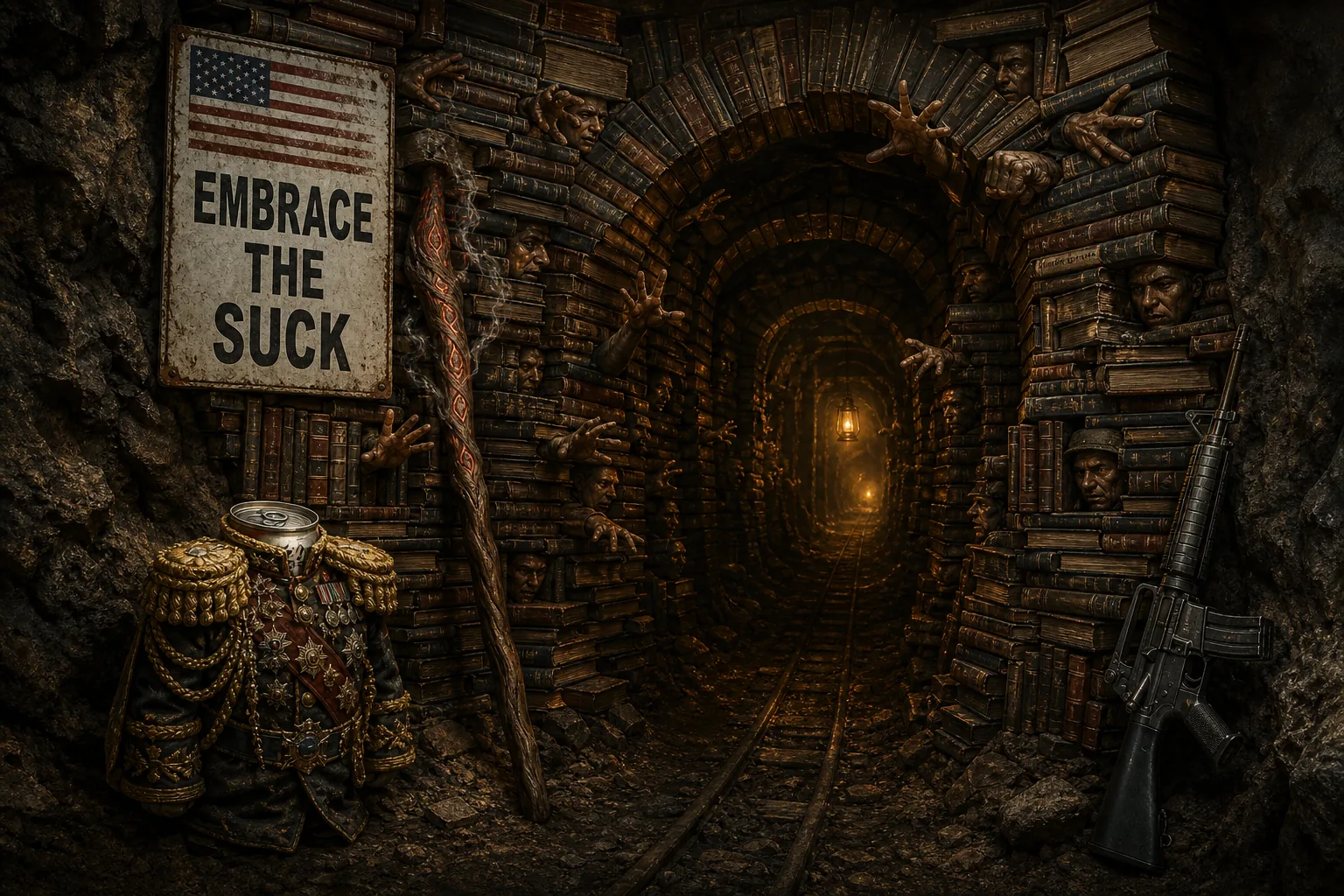
There is a sign above my desk. American flag at the top, black letters on white: Embrace the Suck. It is the kind of thing that hangs in a contractor’s garage or a barracks day room, and I came by it honestly. Afghanistan and Iraq, embedded with the units as a civilian contractor, never in uniform but close enough to the culture to earn the wall space. The sign hangs over the exact spot where I wrote 397,863 words of the worst draft you have ever seen.
Your first draft is supposed to be bad.
Not bad as in “needs a polish.” Bad as in tangled and overgrown. Too much and too little at the same time. That is not the draft failing. That is the draft doing the only job it has. I want to spend the rest of this telling you why, and I am going to use a 641-page Word document to prove it.
Murphy Was Right
Murphy’s Law does not have an exception for writers. It is not impressed by your outline, your vision board, or the fact that this story really matters to you, and whatever can go wrong in a first draft will go wrong, starting on page one and continuing without mercy for four hundred more.
Here is what mine had, in my own accounting. Too many adjectives. Too many weak adverbs. Too much over-explanation. Scenes that ran long and said nothing, and scenes that said everything in three lines when they should have been a chapter. A timeline I was certain ran in order and did not.
Those are not errors I failed to prevent but the residue of thinking on the page, and there is no other way to get the thinking out except to put it there in a tangle and find it later. Murphy does not cause any of it. He just files the report.
The real mistake is the spec. Writers measure a first draft against a published novel, the clean and shaped and final thing, and then feel like failures because the draft does not look like that. It was never supposed to. A published novel is the output of revision. A first draft is the raw ore that revision needs. Grading the ore against a finished blade is how you talk yourself out of writing the only thing that gets you to the blade.
Anne Lamott called it the shitty first draft. She was talking about one book. This is 397,863 words.
The Outline Is a Candle, Not a Blueprint
The obvious objection is “outline harder.” Plan it all in advance and the tangle never happens.
K.M. Weiland makes the strongest version of that case. On her site Helping Writers Become Authors, she argues you can outline thoroughly enough to write a nearly perfect first draft, and she has done it that way since her eighth novel. Her line is hard to argue with: “You will only ever get the chance to write ONE first draft. That draft is your single greatest opportunity to not just create cohesion and beauty, but to create them organically.” She is right. For one book, outline deeply enough and you can write it clean the first time.
I am not writing one book.
Here is how I actually outline at series scale. I outline by candlelight, during a power outage. I can see the next step or two, and I know there is a top of the stairs somewhere above me, but I cannot see it from where I stand and I will not see it until I have climbed most of the way to it in the dark.
That is not pantsing, which has no plan, and it is not Weiland’s blueprint, which has the whole staircase drawn before the first step. It is the only mode that works across eleven books, because you cannot front-load the logic of eleven books before you have written them. You do not learn what Book 7 needs from Book 1 until you have written something close enough to Book 7 to find out.
The outline is a guess. The draft is the answer. The answer is always uglier than the guess, and the answer is the one you can use.
The candle does not light the whole climb. When my first draft stopped at 397,863 words, I was still roughly two hundred thousand words short of the top of the stairs. The mine did not have to be finished. It had to be deep enough to pull the first book out of, and that is a different requirement entirely, the kind you can actually meet without ever seeing the top of the stairs.
The Mine
The draft is a file. 641 pages, 1,731 kilobytes, one Microsoft Word document. When I need a chapter I know I wrote, I go hunting through 641 pages to find it. That is what the suck looks like as a physical object. Not a metaphor. A file with a page count.
Then I started excavating. The file stopped being a draft and became a mine.
Look at what the first eleven chapters were doing.
| Ch | POV | Location | Story Day | What Happens |
|---|---|---|---|---|
| 0 | Agent Lopez | U.S./Mexico Border | Apr 7 | PALE HORSE hunts two young vampires to sunrise |
| 1 | Rocket | U.S./Mexico Border | May 1 | Claws out of her grave; first feeding kills Robert |
| 2 | Ulysses | Saguaro Cerro Estates | May 1 | Bishop briefs him on the Claudia crisis |
| 3 | Warren | Denver | May 1 | A sniper contract kill for Valkyrie’s organization |
| 4 | Vera | Crimson Cabaret | May 2 | Hires Ulysses to find three missing girls |
| 5 | Rocket | Bisbee | May 2 | Meets Bisbee, who clocks her as newly turned |
| 6 | Bisbee | Bisbee | May 2 | Calls Abuela; she demands he kill the social worker |
| 7 | Rocket | Bisbee | May 2 | He refuses to exploit her and names her Rocket |
| 8 | Marigold | Sierra Vista | May 2 | Abuela’s girls brace for a fourth |
| 9 | Trip | Tucson | May 2 | Custody exchange with Paige, returning Asher |
| 10 | Kendra | Crimson Cabaret | May 2 | Feeds on Trip; Kyle arrives |
The story opens with a federal hunter three weeks early, then three chapters land on May 1, in three different locations, each its own storyline, all happening at the same moment. Nine point-of-view characters across eleven chapters. Seven different books seeded before the draft is a dozen chapters deep.
No outline maps that before you write it, because you cannot know those three chapters share a single day until all three exist on the page, so you write them one after another, the draft reads as linear, and only the survey built long afterward reveals that they were concurrent the whole time. There was no way I was holding that in my head accurately. Nobody could.
Now watch the excavation. Parts of TbN chapters 1, 101, 5, 7, 20, 21, and 23 ended up in Rocket, the first published book. Nine of the final sixteen chapters came out of the mine. The other seven, chapter 0 and chapters 2 through 7, were dug fresh.
The non-linearity was specific, and the specifics are the whole point. TbN chapter 1 was Rocket clawing out of the grave. TbN chapter 101 was Rocket telling Warren that same story, the same event retold from memory, a hundred chapters later.
The mine held the scene and the retelling. They sat a hundred chapters apart. And chapter 0, the Managua prologue, the answer to how a fifteen-year-old girl ended up in a shallow grave in the Sonoran Desert in the first place, was not in the mine at all. It had to be dug fresh.
That fresh chapter was not free. To write it I had to build something the mine never contained: “The Road North,” twenty-one notes tracking Naida’s trafficking route from Tapachula to Villahermosa to Veracruz to Mexico City to Hermosillo to the Sonoran corridor to the desert to the grave. The mine told me the destination. The revision built the road that got her there.
And the mine keeps producing. That same draft yielded three finished, published books: Rocket, Babydoll, Blondie. It yielded partial drafts for eight more, among them Crimson Cabaret, Levantadas, Ulysses, Abuela, Cactusflower, Trip, Claudia Clearance Crew, and Sings in Woods. It left a strong compass heading for the final two.
All eleven books in the series have some form of existence, every one of them traceable to a single 641-page Word document, and no single-book “embrace the suck” pep talk has ever had to account for a yield that size. The suck did not produce a chapter I had to fix. It produced a series.
It is not only planning that feeds the mine. Life feeds it. One short story concept came straight out of one of my sons’ worst breakups. The ex-girlfriend is a villain now. Rocket’s whole origin came from somewhere just as real. The candle is lit by everything that happens, the good and the ugly both, because everyone in life is good for something, if only a villain in a vampire novel.
The Magic Is in the Revision
There is a writers’ alignment chart going around, made by @cheyannealepka, that drops the Dungeons and Dragons grid onto how people write. I land in two different cells depending on the phase.
For the first draft I am Chaotic Pantser. That was me at chapter 101, writing it long before I knew where it would land.
For the revision I am Lawful Plotter. That is the published series: twenty-six-column character profiles and twenty-six-column chapter records, with a database enforcing the rules at the server level.
The handoff between those two cells is the entire argument. Chaotic Pantser produces the mine. Lawful Plotter excavates it. You cannot run both modes at once, and you cannot skip the first to reach the second, no matter how badly you want to arrive at the clean draft without first writing the ugly one underneath it.
Weiland is Lawful Plotter from page one, and for one book that works. At series scale it cannot produce the discovery the draft exists to make. The chaos is how you find the map.
The map shows you things the candle never could. When I built the survey, what I thought was in chronological order was definitely not. I built the sheet to be flexible so I could paste chapters in as they arrived, not as I planned them, and the draft needed all kinds of reorganization to meet the timeline once the sheet existed.
The survey does not just sort the mine. It discovers the geometry of the story, which scenes were secretly simultaneous and which book each tangled plotline actually belonged to, and it does that work because twenty active characters had to collide on the page before the five-character books buried underneath them came into view. You cannot map a cast that size before it exists.
There are 108 named characters in the series now. Weiland’s Lawful Plotter knows the socks. Mine has to know it for 108 people, enforced by foreign-key constraints, because a binder of character sheets does not survive that scale. The spreadsheet that holds all of it had to be architected, not just filled in, to carry concurrent scenes and per-book cross-references. That part is its own article, over on ATW.
The discovery does not stop while the draft is still open. Crimson Cabaret is being rewritten right now. I had no idea whether it needed a prologue or what one would even be.
Then, mid-rewrite, the idea arrived: a prologue set in 1892, a hundred and eight years before chapter one. It did not stay one chapter. It grew into two, both set in 1892, and that material (Ochoa staking Mattie mid-turning, orphaning Bill into an incomplete embrace, deciding to carry the lie forward) has become the spine of the whole book.
The Lawful Plotter cannot budget for that. Not just that a prologue will exist, but how many rooms it will need when it shows up. Luckily Excel is as flexible and forgiving as I am. The book surprised me. The spreadsheet got two new rows and moved on.
This is the one place AI enters my process, here in revision and not in the draft, because revision is where the thinking gets done and the model is a far better partner for thinking than for generating into a vacuum. That is all I will say about it.
So embrace the suck. Not as grim acceptance. As permission. If you already know the draft is going to be bad, you might as well enjoy the scenery while you write it.
The phrase came from the military, which borrowed it from what Clausewitz called friction, the resistance that separates the plan from the war and waits inside every operation for the moment it makes contact with the real world. Austin Bay called it “an implied order and wise advice couched as a vulgar quip.” The sign over my desk is not aspirational. Neither is this.
Embrace the suck. Then write the book.
You may also like: - Tracking Your Series & How to Prevent Continuity Issues - Three Phases to Publish - Before You Write a Word