“Keep it PG-13” is the kind of advice handed out by some virtue-signaling do-gooder, the way a person gives out sugar-free candy on Halloween. Sheltered enough to think it helps. That is the house that gets egged, deservedly.
So look at what you are actually reaching for when you reach for that label.
In 2025 the Motion Picture Association handed M3GAN 2.0 a PG-13 “for strong violent content, bloody images, some strong language, sexual material, and brief drug references.” Read that again. That is the descriptor on the friendly tier, the one a careful writer points to when she wants a story kept safe.
Strong violent content. Bloody images. Sexual material. Drugs. All of it inside the rating people invoke as a synonym for clean.
Then there is Crazy/Beautiful, which started life as an R. To hit the more commercial PG-13, the studio ordered the director to cut thirty-five obscenities, bowdlerize a sex scene, and delete the drinking and drug use. The film was a cautionary tale about a girl coming apart. Director John Stockwell described what the rating cost him: “We were trying to make a cautionary tale, and we couldn’t show the behavior we were trying to caution people away from.”
The board did not make the movie safer for teenagers. It took a film whose entire reason for existing was to show a girl what going off the rails actually looks like, sanded off the going off the rails, and then stamped what was left with the tier that markets straight at the kids it had just stopped warning. The rating measures exposure, not harm, and everyone in the building knows it.
That is the thing you are borrowing when you tell a writer to keep it PG-13. Not a moral standard. A sticker.
What PG-13 Actually Is
PG-13 did not come down from a mountain. It was invented on July 1, 1984, after parents revolted over Indiana Jones and the Temple of Doom and Gremlins, two PG movies that put a beating heart and a microwaved monster in front of children. Steven Spielberg pressed for a middle tier. The board built one, and Red Dawn became the first film released under it that August.
It is not a law and it never was. The whole MPA rating system is voluntary, administered by an outfit called CARA, which is a division of the studios’ own trade association. The people who make the movies own the board that rates the movies. That is not a watchdog. That is a marketing department wearing a lab coat.
And it has a revenue logic, which is the part the do-gooder never thinks about. An R restricts the under-17 audience to anyone who brings a parent, which shaves the single most valuable demographic off your opening weekend. PG-13 keeps that audience in the building.
So the commercial pressure runs one direction only, which is to take whatever material would have earned an R and shave it down just far enough to clear the teen-accessible tier, because the studio that keeps its teenagers in the seats on opening weekend keeps the revenue that an R rating would have left standing out on the sidewalk with a parent it could not find.
PG-13 took 51.95% of the domestic box office in 2023, the largest share of any rating, and the all-time top grossers are overwhelmingly stamped with it. The label is not a measure of restraint. It is the revenue-maximizing slot, and the system is built to push content into it.
The Label Points the Wrong Way
Here is where it gets genuinely backwards. The intuition is that R means violence and PG-13 means tame. The data says the opposite happened. Researchers at the Annenberg Public Policy Center tracked gun violence in films and found that it tripled in PG-13 movies after 1985, and by 2012 PG-13 films carried more gun violence than R-rated ones. Lead author Brad Bushman put the consequence plainly: parents see a PG-13 and think it cannot be that bad, when the violence is in fact higher than in the R films they are steering their kids away from. The friendly tier is the one with the higher body count.
Violence migrated down into the teen tier because the board is lenient about it. Sex went the other way. The MPA gates explicit sexual content up into R and NC-17, harder on intimacy than on body count, which is the reverse of how most of the world rates. So what is left to fill PG-13’s sexual register is not the honest act. It is titillation, sex-adjacent behavior, the suggestive ceiling held just under the line, all of it aimed at the exact audience the rating was built to admit.
Peter Debruge of Variety described Sucker Punch, a PG-13, as “fantasy fodder for 13-year-old guys” dressed up as empowerment. The board treats a sex scene as more dangerous than a gun.
Run those two facts together and the friendly label inverts in your hands. The tier that calls itself protective is harsh on the one thing teenagers most need handled honestly and lenient on the carnage. Meanwhile Black Hawk Down, a film that refused to pretty up what a firefight does to a human body, took its R and kept its honesty. R is the honest one. The label you reach for to sound responsible is the one engineered to reach the kid.
It Does Not Even Apply to You
Now the part that should end the conversation on its own. There is no MPA for books. There is no board, no descriptor, no tier. Publishing was asked to build one and refused, and the American Library Association actively opposes rating or labeling books on the grounds that a content sticker is a censorship tool wearing a consumer-safety badge. The medium you write in looked at the film model and said no, for the same reason the craft argument says no: a checklist of what is shown tells you nothing about whether the work is any good.
So when you import “keep it PG-13” into prose, you are not borrowing a standard. You are borrowing a tool from a medium that built it to sell tickets, and applying it to a medium that consciously rejected it.
And the gap it claims to fill was never empty. Plenty of teen girls are finding their way into monster smut, and BookTok may or may not be to blame. There is no rating bug on a Kindle to stop them, because books have no rating body and never built one. That absence is not a hole that wants a label. It is proof that the real gate was always a person exercising judgment.
The parent’s judgment about what a kid is handed. The author’s judgment about what goes on the page. The sticker never existed and the work still got governed, by treatment and by judgment, not by a tier someone in Los Angeles assigned to sell a Friday night.
I will give you my own hard line as the proof. I will not write vampire sex. Not because a rating forbids it, but because it is structurally dishonest, a craft judgment I argued at length elsewhere. The man telling you to stop outsourcing your standards to a sticker draws one of the hardest content lines there is, and draws it on treatment, not on a marketing tier. That is the whole point. The limit is real, and the source of it is mine.
Same Story, Two Treatments
Put two versions of the same premise side by side and the difference between a checklist and a standard becomes obvious. Children stranded without adults descend into ritual violence. That is Lord of the Flies, an allegory sanded smooth enough to feel safe in a classroom, and it is also Yellowjackets, told in full at TV-MA. Same engine. One keeps you comfortable. The other tells the truth about what the engine does to people.
Yellowjackets showrunner Jonathan Lisco named the line his show actually works from. The series, he said, “is not about if cannibalism, it’s about why cannibalism and how cannibalism.” That is treatment over content stated by the maker.
The subject is the same in both tellings. The integrity lives entirely in how it is handled, which is the exact thing a rating cannot see. Toni Morrison’s Beloved carries no rating at all, and the honest screen telling of that kind of horror earns the most restrictive label there is. The label tracks exposure. It never once tracked whether the work was worth reading.
Good Times, Noodle Salad
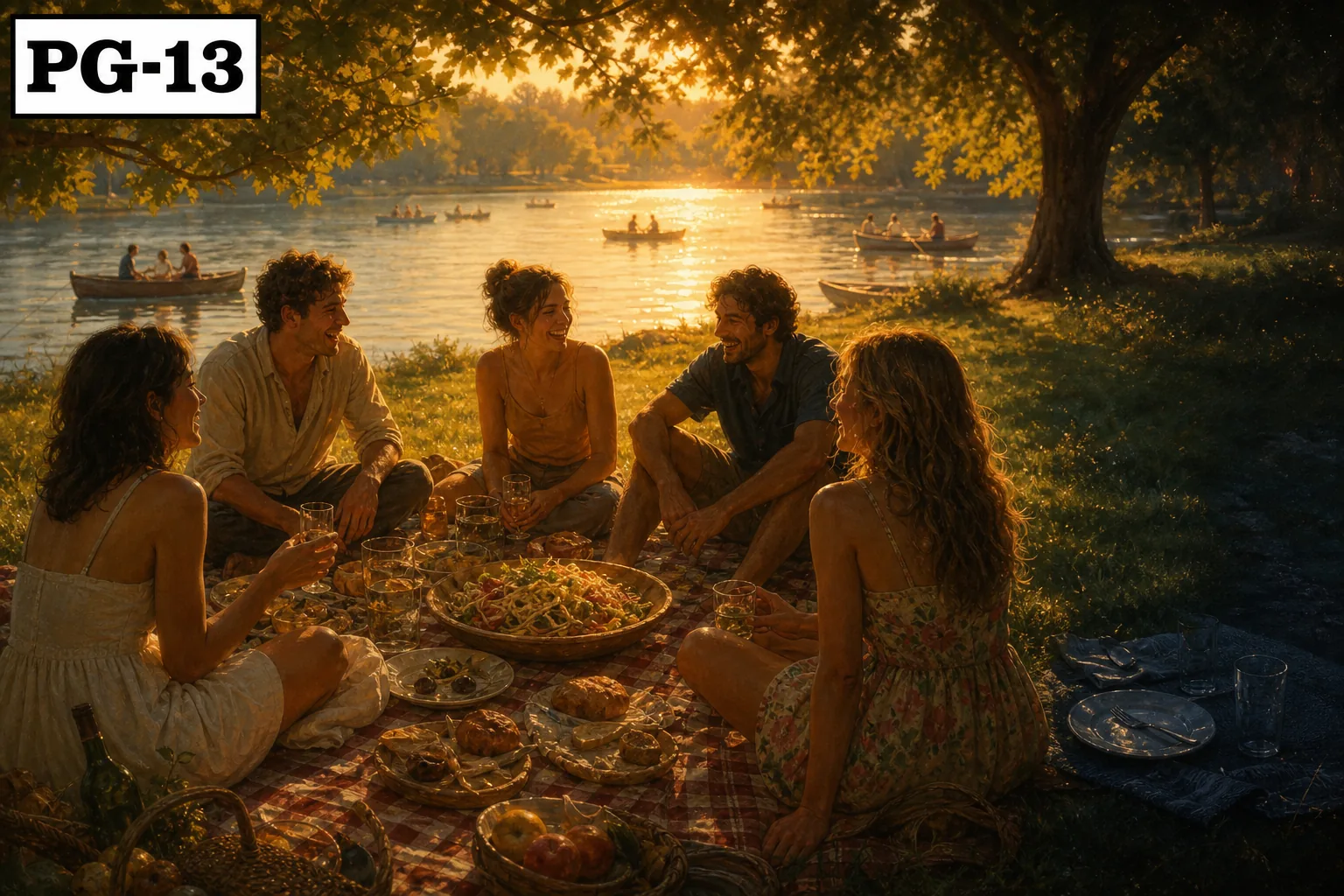
There is a scene in As Good as It Gets where Melvin Udall explains why people resent the unbroken. “Some of us have great stories, pretty stories that take place at lakes with boats and friends and noodle salad. Just no one in this car. But a lot of people, that’s their story. Good times, noodle salad. What makes it so hard is not that you had it bad, but that you’re that pissed that so many others had it good.”
That is the whole argument in a single monologue. The people who hand out “keep it PG-13” had the lakes and the boats and the noodle salad. It was a real story, theirs, and a good one. It was also no one in the car. They want every story to look like the one they were served, and honest fiction is written from the car, by the people who were never at the picnic. Asking a writer to keep it clean is asking her to write the noodle salad she was never handed, and to pretend the car was never on the road.
That is why “sheltered” is a diagnosis here and not a slur. The advice comes from comfort that mistakes itself for safety. It is sincere, which is the problem. You have to be certain you are doing good to hand out sugar-free candy. The certainty is exactly the thing that makes the advice useless to anyone writing from inside the dark.
What to Use Instead
I am not against having standards. I am against ignorant standards. The difference is that a real one is harder, not looser.
A content rating asks a single shallow question: how much is shown. The standard worth keeping asks a harder one: does the story need this, or is it only here for the spectacle. That second question has no checklist and no board to defer to.
It demands that you actually sit with the scene in front of you and decide what it is doing, what it costs, whether the work is honest without it, and whether you put it on the page because the story genuinely needed it or because you wanted a reaction out of the reader that you had not yet earned. That is more demanding than running a tally a marketing department wrote in 1984, not less. Integrity of treatment was always the higher bar.
So when the work goes dark, and the work I write goes very dark, trafficking and trauma and violence on the page, the question is never what tier this would earn. The series is built to handle that material by treatment, by confronting the world as it is, because realism that flinches is not realism. The line is whether the page needs the thing or is just reaching for a reaction.
Think through what your story needs, and what it does not need. If it is gratuitous, or only for shock value, then cut it. That is a standard. “Keep it PG-13” is a sticker.
Don’t outsource your moral stance to Hollywood, which has no morals, or to a marketing standard, which also has no morals. The MPA never rated a book, and it never had any business grading yours. Use your own standards. Do not hand your thinking to some ratings board that was only ever built to sell a ticket.
You may also like: - Room Temperature Bodies Are Not Sexy - The Credential Was the Product or What “Published Author” Signs For in 2026 - Trauma and You...