
The machine in this piece was written by a machine. Claude drafts KANE’s intelligence briefs for Vampires of Tucson, and when I asked Claude to help me prep an article about KANE, its first move was to make KANE the hero. I sent it back. KANE is not the story. Agent Bill Lopez is.
You can’t write what a machine with no body thinks, so don’t try. Write the machine as the MacGuffin that hands out the work. Give it a record instead of a mind, let it be wrong the way its builders are wrong, and put the story on the human in the loop who has to act on what it files.
The AI point-of-view tradition grades its machines on the inside. HAL pleads as the modules come out, Murderbot hides in its shows, and Klara waits at the store window for the Sun, and the test every one of them is held to is whether it feels and whether it wants.
Run that spec and the machine becomes the protagonist by default, because the interior is where you put the camera. KANE is built to a different spec: does its output change what the human downstream has to do, and does its error come from somewhere real?
The Number and the Man
Person of Interest (CBS, 2011 to 2016, created by Jonathan Nolan) ran on one image, a government machine that watches everything and spits out a number, and two men who have to work out what the number means before somebody dies. The number is a Social Security number, because, as Nolan told Annalee Newitz at Gizmodo in 2011, “the easiest way to number people is to use a number that’s already in use.” The Machine hands out the work. Reese and Finch carry the story.
KANE runs the same split. The canon record names him Solomon Kane, the analytic engine of a program called PALE HORSE, and in print he is only ever KANE or Uncle S. Kane, the handle on Lopez’s taskings. KANE hands out the assignment.
Lopez, a Border Patrol agent out of the Bisbee station who still rides a quarter horse named Jefe into the backcountry, goes and does it, and every KANE part in the series, across Rocket, Babydoll, Blondie and Levantadas, comes paired with a Lopez part. The machine and the man were built as one unit.
And KANE has no body on purpose. Characters in the canon database carry a location field, and KANE’s is empty, because when I built the record the answer was that he is everywhere and nowhere, seeing through cameras and taking in signals intelligence from a footprint nobody could drive to.
He stamps everything in Zulu time. He never signs his own name. He rates confidence to one decimal place, and he never prints the word for the thing he hunts; in KANE’s files it’s NOCTURNUS. None of that is an omission. It’s the build sheet.
Thomas Nagel asked in 1974 what it is like to be a bat, and his answer to anyone who thinks they can imagine their way in is that imagining “tells me only what it would be like for me to behave as a bat behaves. But that is not the question.”
A bat at least has a body and a night to fly in. KANE is spread across data centers, and while Klara gets one store window to watch the world through, KANE gets every camera in the country and no place to stand. You can’t write that from inside.
So don’t.
Significance: None
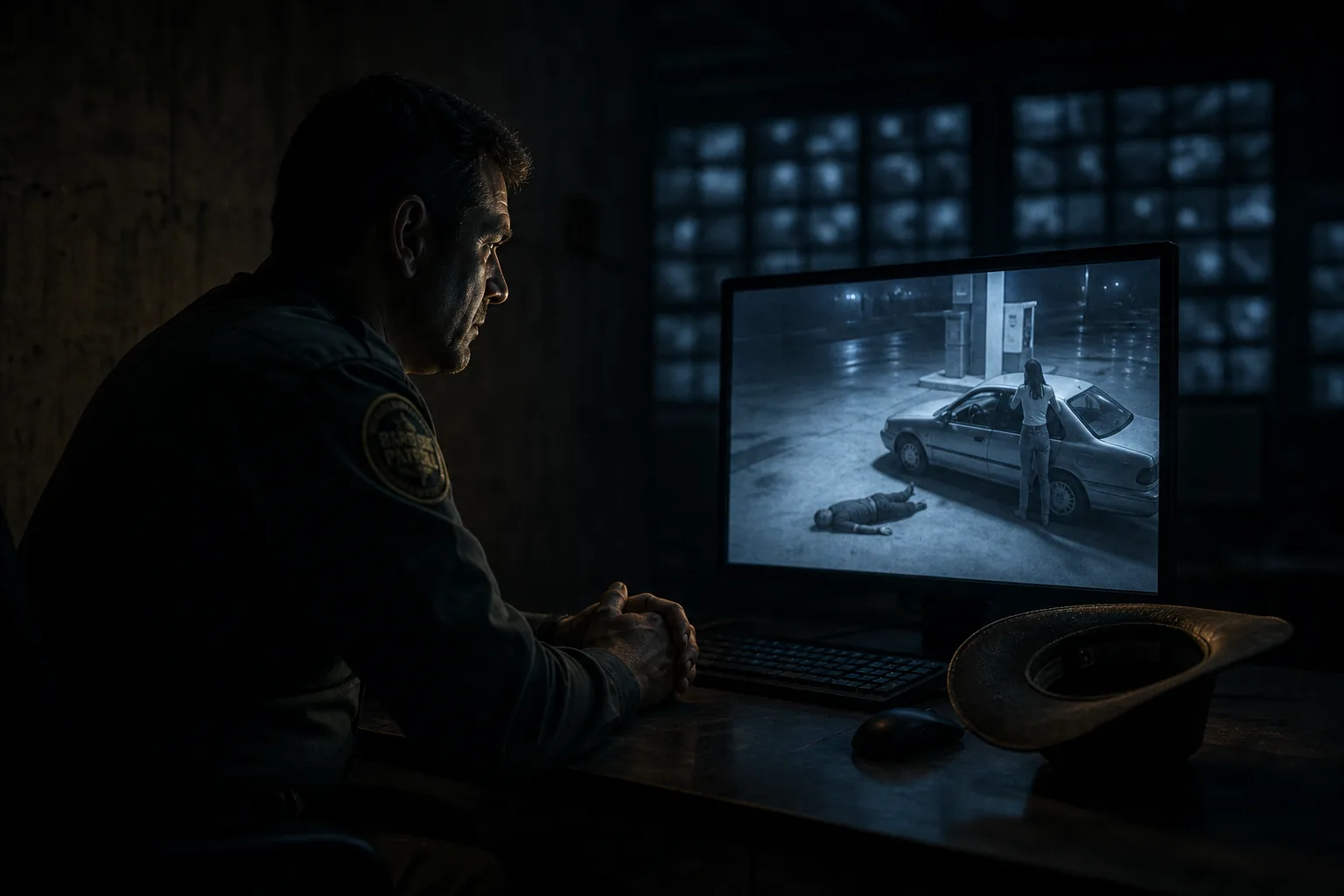
In Rocket 8.2, Rocket feeds on a man at the pumps of a Chevron on Highway 92, and KANE files the station footage frame by frame. The brief logs one detail it can’t account for:
Latency: before she walks, the subject holds still over the man for eleven frames, a little under four seconds. No movement, no feeding, no threat behavior. Nothing in the model predicts it. Significance: none.
A few paragraphs later the same brief reads the Bisbee police theory, a carjacking by a migrant on foot, which gets the man’s death wrong and the stolen car right. “The police narrative graded E4, half right, and stayed as written. Correction was not KANE’s function.”
In Rocket 8.3, the stills land on Lopez’s terminal on Monday morning with a match score under them, 97.3 percent, and he goes through the frames in order, because that’s how he goes through everything. He watches her feed and doesn’t slow down; he’s seen it before.
Then she pulls back, puts both palms flat on the car door, and doesn’t move. He goes forward a frame. She hasn’t moved. Eleven frames. He goes back to the first of the eleven and comes forward through them again, slower.
“He had seen the problem feed before. He had never seen it stop and look.”
Then, in his own head: “Eleven frames. Uncle measured them. I’d bet my pension Uncle thinks they’re nothing.”
Same eleven frames, two readings. KANE measured them to the frame and the second and filed them as noise, because nothing in its model predicted a predator that stops to look at what it did. Lopez measured nothing. He rewound.
The precision belongs to the machine. The meaning belongs to the man. That’s what a record without a mind is for. It keeps the measurement and drops the weight, and the reader watches the weight hit the floor.
Blondie 13.3 runs the same play in a Nogales motel room. KANE inventories the room. The window, taped along every edge in three overlapping layers of duct tape: “Filed as a property detail.” The bathroom mirror gone from the wall, and a motel blanket folded square in the bottom of the tub: “Graded as housekeeping.”
Anyone who has read this far into the series knows exactly what that room is. KANE has every fact the reader has, and it files them as chores, and then the part closes in prose, on Blondie, who “slept the last of the day out in a bathtub.”
The obvious objection is that a machine with no inner life is flat, and readers need a way in to care. KANE isn’t there to be cared about. The format moves the reader’s care downstream, onto Rocket’s eleven frames and onto Lopez rewinding to the first one. The care was never supposed to land on the tool.
The second objection is that this is just epistolary fiction with a security clearance. Fair enough on the lineage. Stoker built Dracula out of letters and diaries in 1897 and trusted the order of the papers to do the explaining. What’s new here is where the character lives. It lives in the grading machinery, in what earns an A1 and what gets filed as housekeeping, and in the loop with the human. It doesn’t live in a voice.
The third is that intel-brief chapters are unreadable as fiction. Each KANE part has a Lopez part beside it, every one carries a short prose frame, and the prose gets the last line. The cost is real, and I pay it in length. KANE parts run 711 to 2,172 words, and they stay short.
No Mary Sue Machines
An AI that is right every time is the AI version of a Mary Sue, and nobody who has ever stood in line at a federal office would believe it was a government program. KANE is wrong a lot, on purpose, and every error comes from somewhere I can point to.
Start with the institution. Government is full of idiots and people building fiefdoms, and KANE inherits both. KANE doesn’t ingest tribal police data from San Xavier or the Tohono O’odham Nation, because the tribes are resisting federal pressure to join the system. A jurisdiction fight became a hole in the machine, and KANE reads the silence on that land as no events.
Richards Heuer described exactly this failure in Psychology of Intelligence Analysis (CIA Center for the Study of Intelligence, 1999): “Experiments suggest that ‘out of sight, out of mind’ is a better description of the impact of gaps in the evidence.” Heuer was writing about human analysts, but KANE was built by an institution and runs that institution’s tradecraft at machine scale, so its blind spots are the builders’ blind spots, now running at the speed of light.
Then the decimals. KANE rates everything to a tenth of a percent, 86.1 here and 97.3 there. Sherman Kent tried a numbered odds scale and wrote in “Words of Estimative Probability” (Studies in Intelligence, 1964) that “given the inexactness of the intelligence data we were working with, the distinctions we made between one set of odds and its fellows above and below were unjustifiably sharp.” One of his colleagues put it more bluntly, charging that the numbers tried “to give language a bogus precision.” Sixty years later KANE prints 97.3 percent with a straight face, and it looks fantastic on the page.
Above all of it sits an Operational Manager at an nsa.gov address who never once writes back. Every notification KANE sends up the chain ends the same way. “No action required.”
The best example of the institution showing through is in the Room 118 brief, where KANE grades the websites a motel resident used to assemble a blood ritual. One of the sources is the Vampire: The Masquerade fan wiki. KANE grades it F6: “The game is a commercial work of fiction, and its rules describe nothing observed in the field.” A federal machine that isn’t allowed to print the word “vampire” just failed a vampire game’s wiki as a source on its own subject, inside a series called Vampires of Tucson. It’s not wrong, either. That’s the worst part.
Then scope. The series carries its own control group. Fang-Bot belongs to one man, DeShawn “CritFail” Booker, runs on hardware in his own house, firewalled hard, working nothing but his problems and always right. KANE belongs to an institution and ingests every county in every state, an assignment God himself would strain at.
| Fang-Bot | KANE | |
|---|---|---|
| Owner | One man (DeShawn “CritFail” Booker) | An institution (PALE HORSE) |
| Scope | His problems | Every county in every state |
| Footprint | A hard-firewalled local rig he owns | Distributed compute, everywhere and nowhere |
| Record | Always right | Often wrong; corrects only as fast as the loop turns |
Same series and same author, and one tool is small enough to be right while the other is big enough to be everywhere. Omnipresence is not omniscience. The intel you have is rarely the intel you need, and KANE has more of the first kind than anything ever built.
The Loop
None of that makes KANE a black box. The intelligence cycle, as the Office of the Director of National Intelligence lays it out, runs six steps and ends on evaluation: “We are continuously evaluating our products for relevance, bias, accuracy, and timeliness.” KANE runs that cycle, tasking Lopez and then reassessing on whatever he sends back from the field.
The record shows it working. In Rocket 4.2, Lopez’s field report on light prints running into an arroyo and none coming out is graded A1, and it’s the second independent source that pushes the file over threshold at 86.1 percent. In Levantadas, the Nogales file closes on a tidy, wrong story and reopens when an open grave and the Love’s footage show a survivor, and in the Room 118 brief the corridor model “was revised on the evidence in this brief.” KANE learns. It learns at the speed of the loop, and no faster.
The Machine in Person of Interest gives too little, a bare number, and the humans have to find the story. KANE gives too much, a finished story with a confidence rating, often wrong. Reese and Finch fill in a blank. Lopez has to see past a conclusion, and that’s the harder job.
In Levantadas 7.1, the closure comes in at twelve minutes past midnight and sits in the basement more than nine hours with nobody to read it, “cold and already decided.” The Bisbee file is closed, every death set down to the girl’s account, line by line. In the middle of it is one line about him. “His assessment of the seventh had been received and given a grade. B3. Noted.”
Lopez reads it the way a man reads his own performance review: “B3. Usually reliable, possibly true. Somewhere back East an analyst is very pleased with how fair that sounds.”
There is no analyst.
The second season of Person of Interest has the same beat. “Relevance” introduces Shaw and Cole, and Phil Dyess-Nugent’s A.V. Club review sums them up: “they’re basically Reese and Finch, but with a key difference: They use the numbers they’re assigned as a hit list.” They believe the numbers come from “A dark room somewhere, where they hurt people badly.”
Human hands on the other end. Lopez believes the same thing about Uncle. Both are wrong about who is sending, and both do the work anyway.
The loop also loses information in both directions. KANE compresses a man who rewound eleven frames into two characters, B3. Lopez already files in two formats, sanitized reports up the Border Patrol chain and the real ones to Uncle, and a man who writes two versions of every report knows a report is an edit. Each side receives the other’s compression and acts on it, and that isn’t a defect in the design. Error is a feature, not a bug, because the error is where the story gets in.
Person of Interest eventually took the other road. Over its later seasons the Machine became a character with a voice of its own. It’s a fine show either way. It’s just the road KANE doesn’t take. KANE stays a record, and the person who matters stays the one reading it.
Who Files and Who Judges
The prep for this article ran the loop on itself. Claude’s first assessment put KANE at the center. I reported back that it had the wrong subject, and the man was the story. Claude reassessed.
Four rounds of that, machine filing and human grading, until the angle you just read came out the other end. I run the same tradecraft on real research with Claude, Admiralty grades and competing hypotheses and all, so the division of labor isn’t a metaphor I borrowed for the occasion. It’s the shop.
Finch got a number and had to find the person. Lopez gets a finished story and has to find the frame it threw away.
The machine measured the eleven frames. The man went back to the first one.
This article came out of the same loop.
You may also like: - The Camera Is Bolted to One Head - Rocket Against the Record, or the Two Places a Protagonist Has to Lie - Every Hat But One, or My Manifesto as an AI-Assisted Novelist