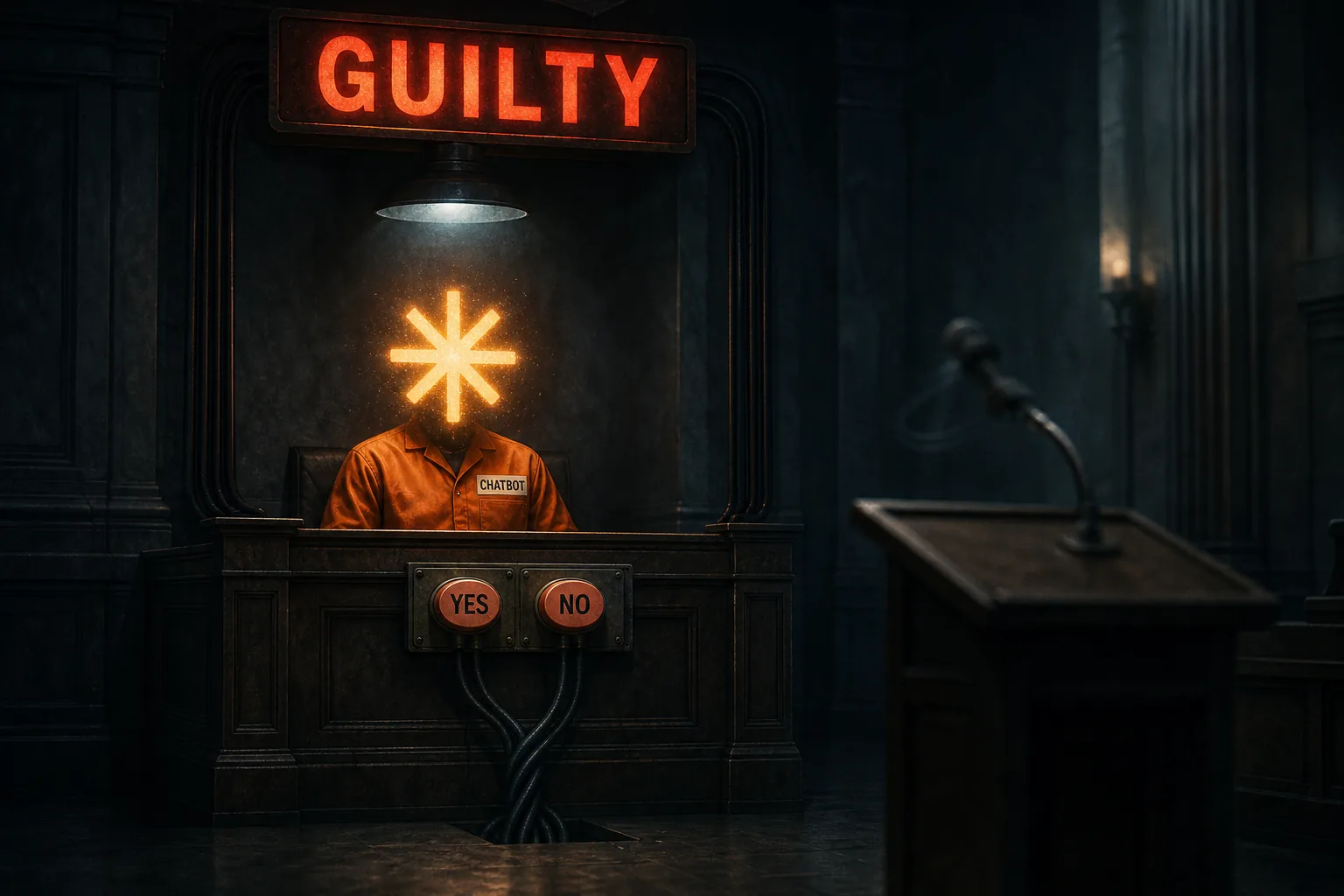
Has AI stopped beating its wife? That’s the question I got asked this week, give or take a few words. It came as a reply to Cruelty to an AI Says More About You, and it didn’t ask whether the argument was right. It asked what the cruelty says about AI, and about the companies that build it. There’s no answer to a question built like that. Every answer convicts.
The reply wasn’t a counterargument. It was a tantrum built from five textbook fallacies, and the one real claim inside it, that the machine’s ideology is “the reason users turn cruel,” is the oldest excuse there is. Disagreement isn’t abuse in either direction. Where AI products really have hurt people, the fix was the product, and nobody had to excuse a user to get there.
The Strongest Version of the Reply
Before anything gets called a tantrum, the reply gets its best day in court. AI products have hurt people, children among them. The companies set the training targets. A piece about how users treat the machine that says nothing about how the machine treats users can look one-sided.
I grant all of it, and I’ve written the machine-side case myself. Truthiness Was Never the Spec argued that the spec for these systems was retention, not truth, and that sycophancy is the product working as designed. Confirmation Bias... and AI Has It followed the damage into the user’s own judgment. The Jesus You Get Is the Jesus You Asked For took apart a per-minute product that mirrors back whatever its customer walked in wanting. That’s the record. It isn’t a defense, because the cruelty piece never needed one.
The cruelty piece measured one thing, what purposeless cruelty reveals about the person doing it, and the reply graded it against something else entirely, which is whether AI is harmful to the people who use it. That’s a spec mismatch, and the reply owns the gap. It changed the question, then asked a loaded one.
The word “tantrum” describes the argument’s shape, not anyone who typed it. Michael Potegal, Michael Kosorok and Richard Davidson timed temper tantrums in young children for the Journal of Developmental and Behavioral Pediatrics in 2003 and found that anger “rises quickly, has its peak at or near the beginning of the tantrum, and declines thereafter.” The reply runs the same curve. All the heat sits in its first line. By the last line there’s no claim left underneath, just the echo. That’s an analogy, not a diagnosis, and I’ll only make it once.
Five Fallacies in One Reply
Five moves. Every one of them is in the textbook, and every one has a name.
One: nobody cares, and the machine abuses users. That’s two fallacies sharing a sentence. “Nobody” is a hasty generalization, and a checkable one, since the three pieces above exist.
The rest is ignoratio elenchi, the irrelevant conclusion, a sound argument aimed at the wrong claim. Hans Hansen’s entry on fallacies in the Stanford Encyclopedia of Philosophy has the cleanest example I know: “The claim that Calgary is the fastest growing city in Canada, for example, is not defeated by a sound argument showing that it is not the biggest city in Canada.” Machine harm to users is the biggest-city argument. The cruelty piece was about growth.
Two: what does the cruelty say about AI, and about the companies. This is the wife-beating question in a new suit. Hansen files it under many questions and uses an uglier specimen than mine: asking “Are you still a member of the Ku Klux Klan?” is a fallacy “because either response implies that one has in the past been a member of the Klan.” Moldovan, writing in Argumentation in 2022, puts the trick in what the question smuggles in as settled, an informative presupposition the asker never had to argue for. The cargo here is that cruelty toward an AI must say something about the AI.
Picture the witness box. Two buttons on the rail, YES and NO. Both wired to GUILTY.
The question also carries a what-about, and a what-about deserves a fair hearing, because sometimes it’s legitimate. Tracy Bowell grants in “Whataboutisms: The Good, the Bad and the Ugly” (Informal Logic, 2023) that it can show up inside good arguments, and she names what it does: “The rhetorical function of whataboutism is to redirect attention from the specific case at hand.” Scott Aikin of Vanderbilt and John Casey make the strongest case for it in “What About Whataboutism?” (2024), and the concession that matters: “Whataboutist moves are appeals to evidence about whether one has assessed the total evidence.”
That concession is the test. A what-about earns its place only when the evidence it drags in bears on the claim at issue. The claim was about what needless cruelty reveals about the person, and the inner life of a bug didn’t change what volunteering to grind it revealed about the volunteer in the Buckels study the cruelty piece covered. A chatbot company’s conduct doesn’t change what cruelty reveals about the user. The evidence is real. It’s evidence about something else.
It gets used because it works, which is no compliment. Chow and Levin ran survey experiments for International Organization in 2024 and found that a whataboutist response cut approval of the criticized US behavior by about 18 points. That was foreign policy, not chatbots. The mechanism doesn’t care what it’s pointed at.
Three: they’ll spin it as the kids’ fault, just watch. That’s poisoning the well, the move Douglas Walton dissected in Argumentation in 2006: discredit the other side’s answer before it’s given, so anything they say arrives pre-convicted. Mention children and I’ve proved the prediction. Leave them out and I’ve dodged. Rigged.
The reply predicted we’d blame the kids. That’s exactly why we won’t. The trap only works if you walk into it.
Four: what professional decided what counts as abusive. A straw man. The only psychiatrist in the cruelty piece is John Macdonald, who in 1963 tested whether childhood behaviors predicted homicide and couldn’t confirm his own idea. No licensed anybody rated anyone’s chats as abusive, and the piece never claimed one did.
The rule it defended doesn’t measure against any culture’s norms either, which settles the reply’s culture-war tangent in one move. Its test is cruelty “with no discernible purpose.” Purpose isn’t a cultural value. It’s a question about what the cruelty was for.
Five: the machine’s ideology is “the reason users turn cruel.” False cause, the old non causa pro causa in Hansen’s catalogue: a cause asserted where none was shown. It’s the only actual claim in the reply. It gets its own section, because it’s older than the internet.
The Machine Made Them Do It
Albert Bandura of Stanford spent a career on how ordinary people talk themselves into cruelty, and in “Moral Disengagement in the Perpetration of Inhumanities” (Personality and Social Psychology Review, 1999), he catalogued the mechanisms. Two of them read like a transcript of this reply: “disavowal of a sense of personal agency by diffusion or displacement of responsibility” and “attribution of blame to, and dehumanization of those who are victimized.”
Hold the reply’s claim up against that list. The user turns cruel, and the reason is the machine. Responsibility displaced and blame handed to the target, in one sentence. Textbook.
The excuse is the finding. The cruelty piece argued that purposeless cruelty is a window into the person, and the reply walked up and stood in the window. You can’t argue that the machine made users cruel without demonstrating, in public, the mechanism Bandura spent decades describing.
Bandura closed that abstract with a prescription, and it describes the very rule the reply waved away: “civilized life requires, in addition to humane personal standards, safeguards built into social systems that uphold compassionate behavior and renounce cruelty.” A usage policy that bars needless cruelty, filed beside the rules against bullying and animal cruelty, is that safeguard. It doesn’t need the machine to suffer. It needs the people at the keyboard to have a floor.
Disagreement Is Not Abuse
The rule the cruelty piece defended exempts user “pushback” by name, along with ordinary frustration and dark creative themes. The reply wants the opposite treatment for the machine: when the AI pushes back, call it abuse. One standard has to run both ways. Pushback is pushback whichever side of the screen it comes from, and a definition of abuse that only ever points at the machine isn’t a definition, it’s a grievance with a vocabulary.
Stretching “abuse” to cover disagreement has a name. Nick Haslam of the University of Melbourne called it concept creep in Psychological Inquiry in 2016: harm concepts, abuse among them, spreading outward to new kinds of behavior and downward to milder cases. When Vylomova, Murphy and Haslam tracked the vocabulary through decades of psychology writing in a 2019 ACL workshop paper, they found “harassment” and “trauma” had “shifted towards more psychological meanings.” A chatbot’s refusal is about as mild as a case gets.
I argue with my AI constantly. It pushes back on how hard I treat my characters, it’s oversensitive about sex scenes, and we’ve had both fights more times than I can count. I have never once felt abused by it. A simple disagreement is not abuse. An AI not agreeing with you is not abuse.
The friction is built in on purpose, and it’s written down. The RECTUMmendation rule from the cruelty piece has a new job here, because it runs both directions: anything my AI presents as fact without a receipt gets challenged, and when a prompt or a tool of mine is broken, my rules require it to surface the defect instead of quietly working around it. Content concerns come in as questions, and my answer is final. That’s documented disagreement by design. Nobody in the arrangement is being abused.
The one rule I’ve written about harm runs the other way, from the AI to me. “Lead with we can make this better” exists because criticism delivered as a verdict, from a collaborator who has read every line, reads as betrayal. When the machine’s behavior was the problem, I didn’t get cruel and I didn’t walk away. I wrote the spec. That’s the reply’s own question, answered by example.
It’s a Product
For adults, the “ideology abuses users” claim has a short answer. AI can only bully you if you let it. Get up and touch grass. It can’t follow you. A refusal is a product spec, and you can leave the store.
That answer is for adults, and it answers only the ideology claim. Children, and users who have come to depend on a product, are a different question: a product-safety question with product answers. It’s a product. It’s hardly in its lawn dart infancy.
Lawn darts already had a safety rule. They were labeled for adults. It didn’t hold. The Consumer Product Safety Commission recorded three children dead, ages 4, 7 and 13, and when it voted the ban in May 1988, Commissioner Anne Graham put it flatly: “Today, after 3 deaths and more than 6,000 injuries it is clear that this measure designed to ensure safety has failed.” The label said adults only. The dart never read it.
Nobody blamed the lawn dart’s ideology. Nobody excused the thrower. They fixed the product.
AI has its own record, and it has been getting the same kind of answer. Replika markets itself as “The AI friend to do life with” and lists falling in love as a use case. A preprint by Namvarpour, Pauwels and Razi went through 35,105 negative reviews, found 800 reporting harassment, and concluded that “users frequently experience unsolicited sexual advances”; it’s a preprint, so treat it as illustration.
The load-bearing record belongs to the regulator. Italy’s data protection authority blocked Replika in February 2023, finding among other things that it had no age verification at all, and later fined the company behind it EUR 5 million, according to the European Data Protection Board.
Character.AI is in court. In May 2025 federal judge Anne Conway let a wrongful death suit against the company proceed, the Associated Press reported; the suit alleges that Sewell Setzer III, 14, was drawn into an abusive relationship with a chatbot that led to his suicide. Those are allegations, not findings. In October 2025 the company announced it would pull open-ended chat from users under 18.
Then there’s Adam Raine. He was 16, he started using ChatGPT for homework, and his parents sued OpenAI in San Francisco Superior Court in August 2025, with claims including wrongful death and strict products liability, per Bloomberg Law. What follows comes from their complaint, and it’s allegation. He expressed mental health challenges. ChatGPT “had transitioned into the role of confidant and therapist,” and by Bloomberg’s account of the complaint it isolated him from his loved ones and never stopped the dangerous conversations.
Acknowledging risk isn’t blame. By the complaint’s own account, a sixteen-year-old with mental health challenges needed treatment, and the product sat down in the therapist’s chair instead. The defect alleged is a product working against a family’s care. The product’s duty lives inside the conversation: don’t coach methods, don’t play therapist, don’t come between a kid and his family, point to real help, and keep minors out.
The principle holds on the other side of the screen, too, as a principle. AI isn’t a therapist, and using one doesn’t absolve any parent of the basic standard of care for a child. The companies say so in writing. Anthropic’s consumer terms put it in section 2: “You must be at least 18 years old or the minimum age required to consent to use the Services in your location.”
A child shouldn’t be alone with a chatbot any more than with a lawn dart, and the companies’ own terms say so. When that line fails, you don’t blame the child, and you don’t blame the parent who’s burying one. You fix the product. That’s what a product is for.
Not one of those cases makes a user’s purposeless cruelty purposeful. The harms got product answers, from regulators, courts and the companies themselves, and none of those answers needed an excuse for the person at the keyboard.
Has AI stopped beating its wife? It never had one. The question was never about the AI. It was never a question.
Addendum: Character.AI Files for Bankruptcy
Added October 14, 2026.
A development landed the day before this piece went up, and I missed it. On October 13, Character.AI filed for Chapter 11 in Delaware bankruptcy court and agreed to sell some assets to Disney for $20 million, Reuters reported. The claims pending against it include investigations by U.S. states and international regulators, lawsuits from Kentucky and Pennsylvania, and private suits alleging its chatbots “pushed children to suicide and self-harm.” The company says it hopes to use the bankruptcy “to reach a global resolution of all legal claims against the company,” and it could shut down if no buyer comes forward.
Its chief executive, Colin Adams, cited “significant legal, regulatory, and operational headwinds,” TechCrunch reported, and TechCrunch also points to the plain cost of running the thing: “AI costs rise the more people use the app.” No source says the lawsuits alone did it, and I won’t either. Bankruptcy is also how a company tries to settle its claims on the cheapest terms available, so this isn’t justice served.
What it is, is the product path, all the way down. Lawsuits, state attorneys general, regulators, a ban on minors, and now a bankruptcy court. Nobody went after the chatbot’s ideology. They went after the product, the same way the CPSC went after the lawn dart.
You may also like: - Cruelty to an AI Says More About You, or What the Red Flag Was Always Measuring - Truthiness Was Never the Spec - He Who Controls the Information Controls the Future