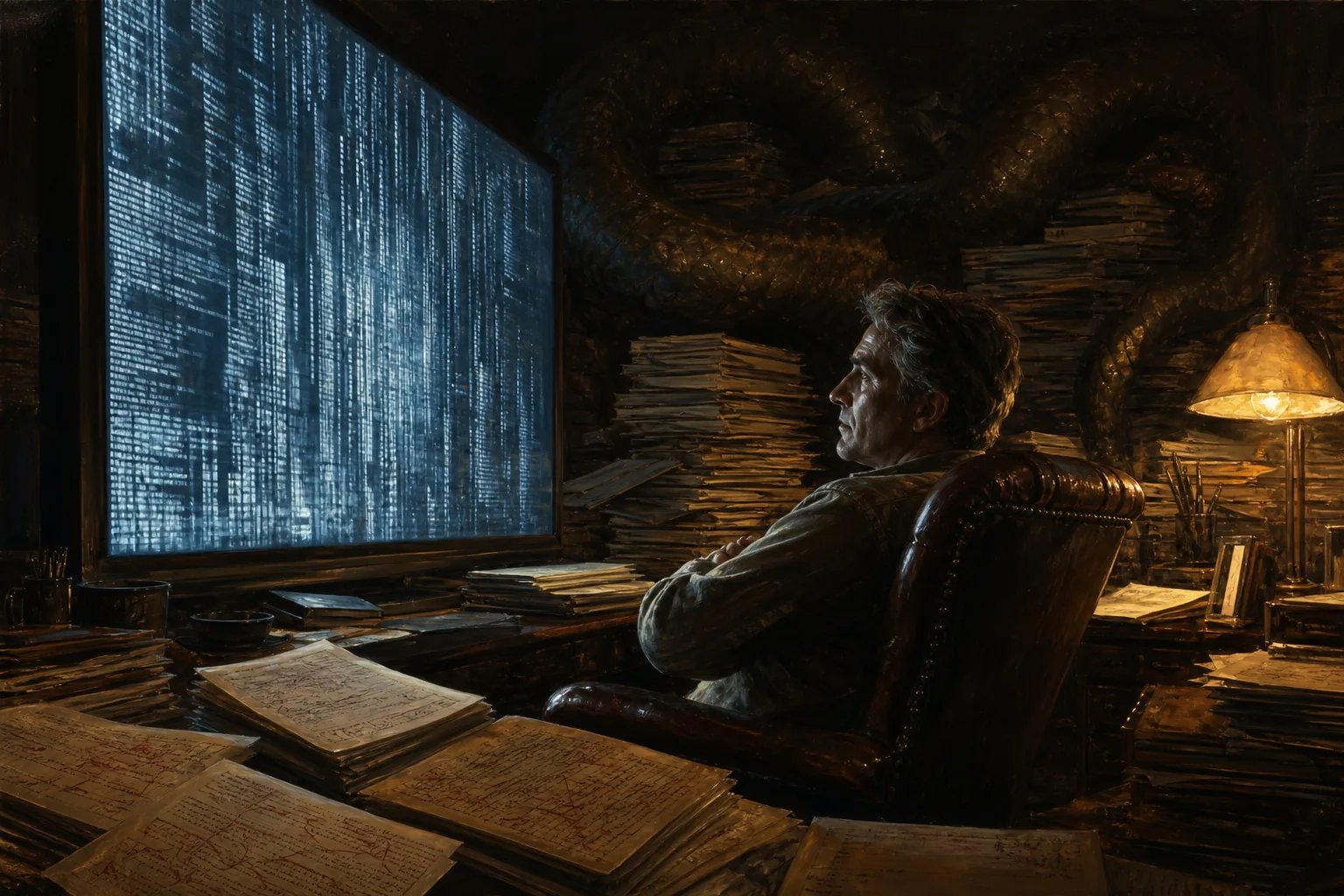
Here’s what thirty years in IT and one very embarrassing ChatGPT session taught me about writing with AI: the problem isn’t that it can’t write. The problem is that it has no self-control.
I came to AI the same way I come to everything. Skeptical. Arms crossed. Waiting to see what would shake out once the marketing deck hit reality.
I have watched technology arrive with promises it couldn’t keep my entire career. Every system that was going to change everything. Every platform that was going to revolutionize the workflow. I have deployed those systems. I have watched them get quietly decommissioned eighteen months later when nobody could figure out how to make them do what the pitch promised. I know how this goes.
So when AI arrived, I was not exactly rushing to the front of the line.
Here’s the other piece of it: I can write. Two thousand words an hour, when I’m on. The problem is what I end up with is dialogue. Tight dialogue, natural-sounding characters, people who say exactly the thing.
Ask me to write about a painting and you will get two people standing in front of it arguing about its merits. Neither of them will describe the actual painting. (I am not an art critic.) Prose - scene-setting, place rendering, the kind of writing where you put a moment into actual words - that’s the gap.
So I had a reason to try. And I had nothing to lose. What was the worst that could happen - it would steal my idea? I have yet to see an AI publish a book on Amazon. How stupid are humans? by A.I. Claude. The market is wide open.
Then I tried it anyway. Because I’m an idiot who writes novels, and I needed someone to handle the painting.
I went in the way most writers go in - through the front door, straight to the obvious use case. I had hundreds of pages of carefully designed canon documents. PDFs with real formatting. Word documents with actual structure. I was building a series, and I had done the work.
Organized. Documented. Formatted like someone who gives a damn.
I fed all of it to ChatGPT and asked it to help me write.
I cannot explain it better than this: it was like a Penthouse letter. I don’t usually do this kind of thing. I can’t believe this is happening to me.
There I was, balls deep in ChatGPT, watching it make a beautiful hash out of everything I’d handed it. It couldn’t read the documents properly. It invented details that weren’t there. It hallucinated relationships between characters I’d never written. It was creative, I’ll give it that - just not with my material. It was performing creative with a parallel universe version of my series that bore a family resemblance to what I’d actually built and shared absolutely no DNA with my actual story.
I sat there in my LazyBoy and thought: I know this problem.
The tool isn’t broken. The data layer is wrong.
Thirty years of IT. One principle survives everything: if you can’t bring Mohammed to the mountain, the mountain comes to Mohammed.
I spent longer than I’m going to admit converting all my pretty, artfully designed documents into ugly structured data. Ugly by human standards, but gorgeous to a machine. The PDFs became queryable records. The Word documents became fields with defined values. Everything that made them readable to a human - the formatting, the visual hierarchy, the presentation - got stripped out and replaced with structure that a machine could actually navigate.
It worked, not perfectly and not immediately, but it worked in the direction of working, which was more than I’d had before.
That solved the data problem. It didn’t solve the other problem.
Here’s the thing nobody told me upfront, and the thing I had to figure out the hard way: AI can write. Let me be clear about that. It has been trained on hundreds of terabytes of human writing - literary fiction, journalism, academic prose, the entire cultural output of a civilization that has been writing things down for a few thousand years. The capability is there.
The problem is that it has no self-control.
It can’t tell what’s good. It can’t tell what’s bad. But it knows - with extraordinary precision - what patterns the human evaluators who rated its training outputs rewarded. And it spams the ever-loving shit out of those patterns.
The em dash. The three-part parallel structure with a punchy close. The sentence fragment for effect. The rhetorical question that opens a section. The pivot from concrete to universal. The callback to the opening in the close.
These are real writing moves. Good writers use them. Occasionally. When the sentence earns it.
AI uses them forty times in a post. Because forty got a higher thumbs-up rating than zero.
You are not reading a writer. You are reading pattern recognition with a thesaurus.
The technical term for the output is slop. The actual term, in my house, is less printable.
The fix is a standards document.
A set of rules - actual rules, written down, enforced on every single draft - that tells the AI what it can and cannot do. Em dashes are banned. Corporate filler is banned. Stacked rhetorical questions are banned. Every opening sentence has to earn its place. And there has to be a moment of dark humor in every post, because dark humor is the one thing you genuinely cannot generate - the shape of a funny line without the person who finds something funny in a slightly uncomfortable way is just a shape.
This is, for the record, exactly what I would do with any other system that had no self-control. You don’t fix a system that lacks discipline by hoping it will develop discipline. You build the guardrails into the architecture. That’s not novel thinking. That’s Tuesday in IT.
Without the standards document: slop. Pattern recognition in a hat, performing depth while achieving nothing, sounding vaguely like a LinkedIn post that went to film school.
With the standards document: output that sounds like me, holds a coherent argument, and doesn’t make me want to light the laptop on fire.
With the standards document, I still sometimes get slop. When I do, I go back to the document, figure out what rule I was missing, and add it.
I have been iterating on that project ever since.
That iteration only works because the document forces you to be specific. There is a difference between saying “I don’t like this” and actually being able to communicate what was wrong with it. A vague “it sucks” is not a meaningful argument - it’s just hate wearing a smoking jacket. Unless you can chew the WHY down to the bone, you aren’t solving a problem. You’re just having feelings about it.
As far as I can tell, AI is just another tool.
Same as WordStar was on my 286. Same as WordPerfect on the 386. Same as Microsoft Office, or OneNote, or - and this one tends to make people squirm - having a research assistant. Several published authors have research assistants. Nobody convenes a panel.
I don’t see it as any different than a critique group or beta readers. Both of which are also people who help you make your work better, and neither of whom you would expect to sign an NDA.
I don’t need AI to sign an NDA anyway. Because who is it going to tell?
Paying for it is hella cheaper than a research assistant. Or a critique group. Or beta readers, who require feeding.
The dragon isn’t tamed. The document isn’t done. I will be updating it until I stop writing, at which point it will be someone else’s problem.
That’s not a failure condition. That’s the whole job.
I came in skeptical. I’m still skeptical. Skepticism is why the system works - because a skeptic doesn’t accept the first output, or the tenth, or the fiftieth. A skeptic reads the output, identifies the failure, and fixes the underlying cause rather than hoping the next draft is different.
The Penthouse ending I expected: and then I became a believer. I came, I saw, I laughed my ass off.
The actual ending: and then I debugged the problem.
Less romantic. Fewer bodily fluids. Far more work, and much more mess to clean up. Works considerably better.
You may also like: - Have Some Standards When You Use AI to Write - AI Does Exactly What You Ask, or What ‘Slop’ Actually Names - The Standards Document