On 21 July 2026, Substack switched on an AI detector. It scanned posts, notes, replies and comments longer than a hundred words and handed back a score. I read the announcement, cancelled every paid subscription I had ever sold, refunded the money, ended serialization on the platform, and moved three books onto infrastructure I own.
Nobody passed a law. There was no defendant, no standard of proof, no hearing, no record, and no appeal. A scanner returned a number, and the number was the verdict.
That is the kind of power worth being afraid of. Not because it is the largest, but because it is the only kind that operates with no process at all, and the AI regulation that both parties are now racing to build hands exactly that power to whoever wins the next election.
I made a poster about it. It is my own satire, not a found document: Notice No. 4 of a ministry that has never existed, printed in the house style of one that does, in a novel.
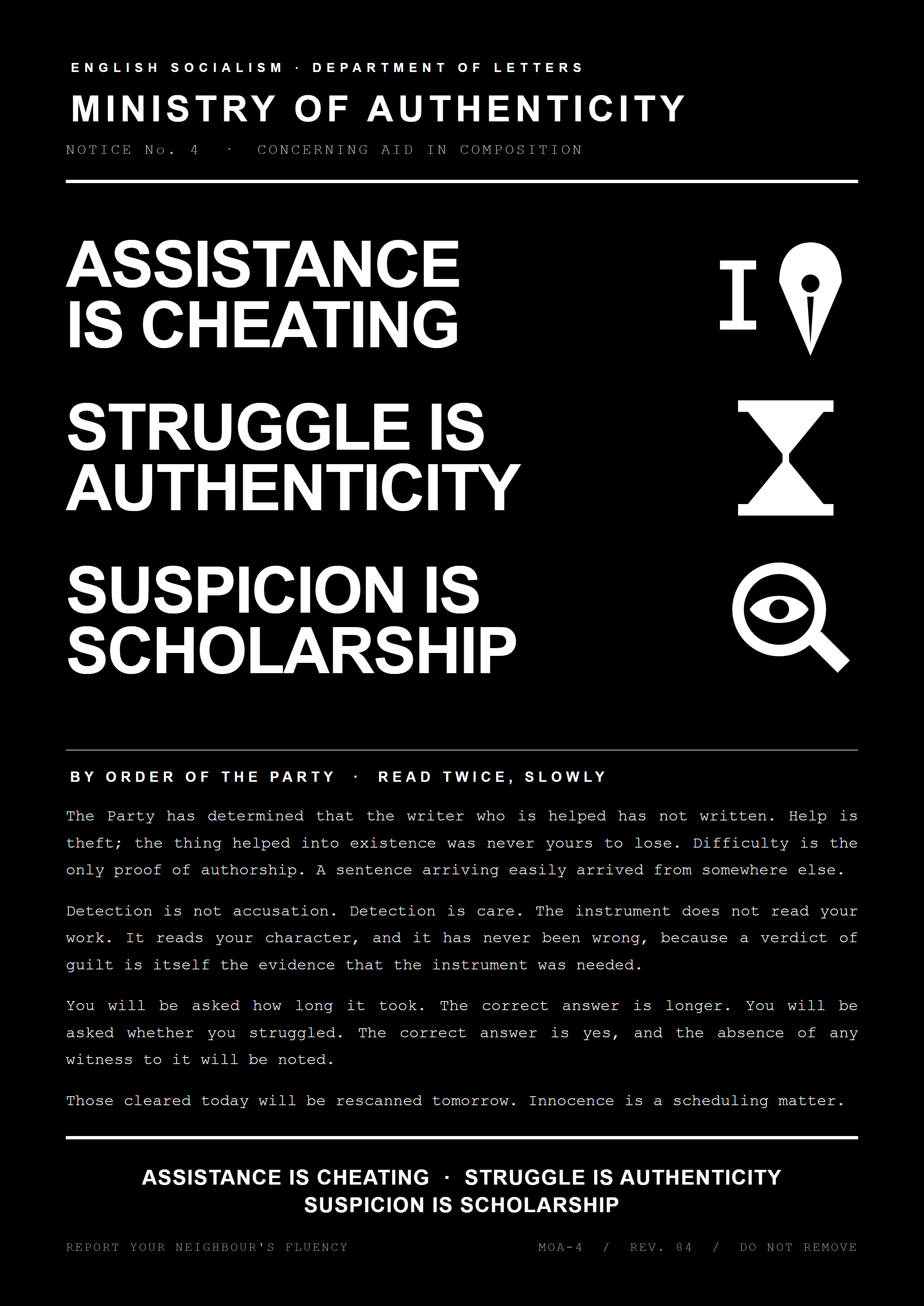
The joke underneath it is the part that is not a joke. An instrument calibrated to read character rather than work cannot return a false positive, because a verdict of guilt is itself the evidence that the instrument was needed. Nobody is ever cleared, either. They are only scheduled. Innocence is a scheduling matter.
One housekeeping note before the rest, since the whole subject here is who gets to certify what is true. Nothing load-bearing in this piece comes from a fact-checker, a think tank, or an advocacy organization. It comes from a Supreme Court opinion, congressional releases, a European Parliament transcript, peer-reviewed papers with named authors, polling with published field dates and sample sizes, and the subjects’ own words.
The Week the Question Got Adopted
On 12 September 2026, Dario Amodei published “We Must Pace the Frontier.” The week around it is the cleanest adoption event I have ever watched happen in real time, because everybody showed up on camera within about seventy-two hours of each other.
Amodei’s policy position, laid out in “Policy on the AI Exponential”, is that the government “should have the power to block or deter deployment of the model if it is determined, in light of third-party assessment, to present unacceptable risks,” alongside permanent evaluators embedded in frontier labs in partnership with government, applied to every US frontier lab.
He scopes it, and the scoping is careful. The power is limited to four named risk domains, cybersecurity, biological weapons, loss of control, and automated R&D. He writes that there must be protective measures against political favoritism and arbitrary decisions. Hold onto that clause.
He did not stay out there alone for long. Within hours Sam Altman posted that he agreed on pacing the frontier and called independent evaluators with employee-like access a good idea. Elon Musk wrote that Dario is right, then floated peer review of AI by competitors. By Sunday the people running the largest labs in the country had converged in public on the same ask, which is what makes this an adoption event rather than one executive’s blog post.
David Sacks, the White House AI czar, answered on X the next day, on 13 September, and his answer was three parallel refusals: “Stop pretending you need anyone else’s permission.” “Stop pretending antitrust law has to be suspended so you can form a cartel.” “Stop pretending you need a regulatory approval process.” He argued in the same thread that METR is “not independent” because it is “intertwined with Anthropic’s investors and staff,” and that the slowdown push is partly driven by product-liability exposure rather than by safety alone. Liz Wolfe carried the exchange at Reason on the 14th.
Two days before that, on 11 September, Barack Obama spoke at a private fundraiser in Manhattan alongside Hakeem Jeffries. “This is something that is moving very fast in private hands,” he said, “and if we don’t get on top of it, I think can be dangerous.” His instruction to Jeffries was procedural rather than substantive: “Once you are speaker, I would strongly urge that the Democrats put together a framework for a very public conversation.”
That is a former president telling the likely next Speaker to have the framework ready for the day the gavel changes hands. Note what the sentence does not contain. It does not contain a claim about what the framework should say.
Now hold that next to the instrument the other party already built. On 11 December 2025, the President signed Executive Order 14365, “Ensuring a National Policy Framework for Artificial Intelligence.”
It directs the Attorney General to stand up an AI Litigation Task Force whose sole job is challenging state AI laws. It directs Commerce to identify state AI statutes it considers onerous and to make those states ineligible for undisbursed Broadband Equity, Access, and Deployment money. That is roughly twenty-one billion dollars of leverage pointed at state legislatures.
The grounds the order names for a challenge include whatever is “otherwise unlawful in the Attorney General’s judgment.” Gibson Dunn’s client alert, written by named attorneys four days later, reads it the same way.
One side has a fundraiser and a plan for after the election. The other side has a signed order, a litigation task force, and twenty billion dollars. Neither of those is a hypothetical, and the one already in force is not the smaller of the two.
There is an older piece of evidence about what happens to a claim in political transmission, and it happens to be the most quoted sentence in modern American politics. Reagan, First Inaugural, 20 January 1981: “In this present crisis, government is not the solution to our problem; government is the problem.” Four words at the front do all the work, and those four words almost never survive the trip. What circulates is a permanent philosophical position. What he said was a scoped claim about a specific year. The qualifier got stripped and the doctrine got kept, which is the same operation this piece is about to document three more times.
The Cycle, Run Once
Climate went first, and it supplies the cleanest example of the retreat.
The IPCC’s Fourth Assessment Report, Working Group II, section 10.6.2, said that “the likelihood of [the Himalayan Glaciers] disappearing by the year 2035 and perhaps sooner is very high if the Earth keeps warming at the current rate.” That is a dated claim, vividly stated, in a flagship document, and it was excellent at mobilizing people. In January 2010, the IPCC conceded in its own statement that the claim was poorly substantiated, that it had not come from peer-reviewed literature, and that its own well-established standards of evidence had not been applied properly. The statement expresses regret.
I am not arguing the underlying physics is wrong, and I want that stated plainly rather than buried. I am arguing that the scorecard gets graded on a curve.
Take the paper that is usually handed over as the rebuttal. Hausfather, Drake, Abbott and Schmidt evaluated seventeen model projections published between 1970 and 2007 in Geophysical Research Letters in 2020, and the headline is that the models were skillful. Then read the table.
Nine of the seventeen assumed forcings that landed inside the observed range. The other eight assumed forcings significantly stronger or weaker than what actually happened. On the plain test, temperature against time, ten of seventeen came out consistent with observations and seven did not. Four ran hot. Three ran cold.
The fourteen-of-seventeen number everybody quotes arrives only after the metric changes. It comes from what the authors call implied TCR, which regresses temperature change against the forcing that actually occurred instead of the forcing the model assumed. As a way to test physics that is entirely defensible. As a test of a prediction it is not one, because you have substituted what happened for what was projected and then scored the remainder. A projection whose inputs get corrected after the fact was never exposed to failure.
The same lead author put the current generation on the record two years later. Ten of the fifty-five CMIP6 models carry a climate sensitivity above five degrees per doubling, and Hausfather and his coauthors wrote in Nature that the ensemble should be screened down to the models sitting inside the IPCC’s own likely range rather than used as delivered. That is the evaluators telling you the instrument needs a correction factor before you quote it.
What failed was falsifiability. A dated claim is a claim that can lose. When 2035 started looking expensive, the institution retired the number rather than the authority that the number had built, and somewhere in the same stretch “global warming” became “climate change,” which is a term no observation can embarrass. A framework that cannot be contradicted by any observation is not a scientific position. It is a permanent one.
The enforcement mechanism in this round was prestige and nothing else. Nobody could block your speech over it. They could only be disappointed in you at length.
And the sorting took a decade: Aaron McCright of Michigan State and Riley Dunlap of Oklahoma State tracked the partisan split opening across 2001 to 2010 in The Sociological Quarterly, and their central finding is the one that matters later in this piece: elite cue-giving came first, and the public and legislative sorting followed it.
The Cycle, Run Again, With Teeth
COVID ran the same retreat and added an enforcement arm.
The six-foot rule governed the physical movement of three hundred million people for two years. Anthony Fauci told the House Select Subcommittee on the Coronavirus Pandemic that it “sort of just appeared” and that he was not aware of studies supporting it. The costs of what that rule justified are measured and public: Thomas Kane of Harvard’s Center for Education Policy Research and Sean Reardon of Stanford built the Education Recovery Scorecard across roughly eight thousand districts, anchored to NAEP, and the losses concentrated in low-income communities.
The trial endpoint was always severe illness, and Pfizer had said so since 2020. The mandates were sold to the public on transmission anyway, which is the gap that matters. On 10 October 2022, in front of the European Parliament’s Special Committee on COVID-19, MEP Rob Roos asked Pfizer’s Janine Small whether the vaccine had been tested for stopping transmission before it entered the market. Her answer was that no, they did not know, and that “we had to really move at the speed of science to really understand what is happening in the market.” Nothing about that was a revelation. It had been in the New England Journal of Medicine since December 2020. The revelation is that it never reached the podium.
Dissent got handled rather than answered. On 8 October 2020, NIH Director Francis Collins wrote to Fauci about the Great Barrington Declaration and its three authors, Martin Kulldorff of Harvard, Sunetra Gupta of Oxford, and Jay Bhattacharya of Stanford. Collins called them “three fringe epidemiologists” and wrote that “there needs to be a quick and devastating takedown of its premises.” Those are three chairs at three of the most selective universities on earth. The word “fringe” was doing a job, and the job was not description.
Then the mechanism went to court. In Murthy v. Missouri, decided 26 June 2024, the Supreme Court dismissed the case 6 to 3 on standing, Justice Barrett writing. The plaintiffs could not trace their specific content moderation to specific federal pressure.
What the Court did not do was draw the line between permissible government persuasion of a platform and impermissible coercion of one. So the mechanism was used, litigated for three years, and never adjudicated. It is still sitting there, fully loaded, available to the next administration that wants it.
The sorting on this one took about six years, and it finished on party-line votes. Bhattacharya was confirmed as Director of the National Institutes of Health by the Senate, 53 to 47, on 25 March 2025. In August 2026, the Senate Homeland Security Committee voted 8 to 7 to hold Fauci in contempt. The dissenter was not vindicated by evidence. He was vindicated by an election.
The Part Where I Have to Be Consistent
If I object to state power aimed at speech, I do not get to cheer when it is aimed at people I think deserve it. So here is the distinction I am actually drawing, and it is not a distinction between my side and yours.
Jawboning is power aimed at expression. It has no defendant, no charging document, no standard of proof, no hearing, no record, and no appeal, which is precisely why Murthy could run for three years and resolve nothing. There was never a proceeding to review. Prosecution is power aimed at conduct, and it runs through indictment, discovery, an evidentiary standard, a jury, and appeal. Those protections are the entire point.
Fauci invoked the Fifth Amendment over a hundred times in front of Congress. That is a protection the throttled accounts of 2021 never had, and I am not going to pretend it is not one.
Now the part that costs me something. Three state attorneys general, James Uthmeier of Florida, John McCuskey of West Virginia, and Liz Murrill of Louisiana, issued an investigative subpoena to Fauci in August 2026, covering documents from 3 January 2020 forward and returnable on the 31st.
The subject is alleged self-dealing: a Dan David Foundation prize of roughly nine hundred thousand dollars, a NIAID grant to a University of Florida program, named professorships, book deals and board seats held concurrent with federal office. Uthmeier’s framing is careful and worth quoting exactly: “Government officials have a certain level of immunity in their official capacities, but if Fauci personally profited off of the ‘guidance’ he issued, that very well could have broken Florida law.” Kyla Guilfoil reported it for NBC News on 5 August 2026.
John McCuskey put the purpose plainly: “The American people deserve to know if they or their elected leaders were misled or manipulated.”
It is an investigative subpoena. It is not a prosecution, and no charges exist. It is also not blocked by the pardon, for reasons that have nothing to do with anybody’s guilt. Biden’s preemptive pardon, issued 20 January 2025, covers federal offenses committed between 1 January 2014 and 19 January 2025, and a presidential pardon has never reached state law. Three state attorneys general are working state authorities, and anything after 19 January 2025 falls outside the window anyway. That is the doorway, and it is narrow.
And there is a prior step that nobody on my side of this argument likes bringing up. A Florida statewide grand jury sat for eighteen months on pandemic conduct and reported, in its own final report, that it “did not find any statute that we believed would be an appropriate vehicle for a criminal indictment.” A process ran. It returned an answer. The political principals then came back with a different instrument, one built out of consumer-protection authorities, deceptive trade practices and public nuisance among them. I recognize that move, because it is the same move, and the principle either binds in both directions or it is not a principle. It is a preference with good lawyers.
What Makes the Third One Different
Climate and COVID each got years of public argument before the sides finished hardening. This one took a week, and the reason the compression matters is what sits at the end of it.
The retreat on AI is already on the record, and unusually, it is on the record twice from the same office.
On 28 May 2025, Amodei told Jim VandeHei and Mike Allen at Axios that AI could eliminate half of entry-level white-collar jobs and push unemployment to ten or twenty percent within one to five years.
On 5 May 2026, in Fortune, he reached for the Jevons Paradox: “If you automate 90% of the job ... then everyone does the 10% of the job. And the 10% kind of expands to be 100%.” On 24 July 2026, Anthropic’s own head of economics, Peter McCrory, told the same magazine: “I don’t see significant impact of AI on the U.S. labor market.”
The ask sits in the middle of that sequence rather than after it. The Jevons walk-back came in May, the policy essay in June, the head of economics in July, the pacing essay in September. The forecast kept shrinking. The ask did not.
Here is the dark comedy of it, and I want to be fair by stating it as a sequence rather than a smear. The man who forecast ten to twenty percent unemployment inside five years, and who now explains that the remaining ten percent of the job expands to fill one hundred percent of it, would like permanent government evaluators installed inside every frontier lab. His competitors’ first.
Grant the strongest version of his case anyway, because it is genuinely strong. It is strange that a technology this consequential sits under the control of a handful of executives nobody elected, answerable to a board and a cap table rather than to a public. “Leave it to the market” is not an answer to that, and anybody who says it is has not thought about it for ten minutes. Amodei is not stupid and he is not lying.
The answer is not that he is wrong about the problem. It is that unaccountable private power and discretionary political power are not a choice between a danger and a safety. They are two failure modes, and exactly one of them can also rewrite what the machine is permitted to say. Private failure produces a bad product. Political failure produces a compliant one.
There is a second asymmetry underneath that one, in what each fear is built out of. Distrusting a private company is a forecast. You are reasoning from incentives toward a thing that has not happened yet.
Distrusting the government on this particular question is a reading of a record, and the record is everything above: a flagship claim quietly retired while the authority it built stayed put, a rule that governed the movement of three hundred million people with no study behind it, a pressure campaign litigated for three years and never adjudicated, and a blacklisting a federal judge threw out as retaliation. One of those two cases is speculative. The other one has citations.
And the record does not start in 2020. The Public Health Service ran the untreated syphilis study at Tuskegee for forty years, on six hundred men, withholding treatment long after penicillin was available and never taking informed consent. The government removed roughly a hundred and twenty thousand Japanese Americans from their homes on the strength of one executive order, most of them citizens.
Notice why both are available to quote. Tuskegee ended in a ten-million-dollar settlement and a presidential apology. The incarceration ended in an act of Congress calling it a grave injustice driven by racial prejudice, war hysteria, and a failure of political leadership, and in eighty-two thousand redress payments. Both are citable because the government that did them eventually wrote the confession down.
Waco is the harder case, and it belongs here precisely because it does not run the way the other two do. John Danforth’s special counsel investigation cleared the government of the central charges: agents did not start the fire, did not shoot into the compound, and he assigned responsibility for the deaths to Koresh and the Davidians.
What he did find is narrower and worse for the argument I am making against. Members of the Justice Department’s own trial team knew in 1993 that pyrotechnic tear gas rounds had been fired, and chose not to disclose it to the Davidians’ defense lawyers or to Congress. Not to others inside their own department either. It surfaced in 1999, six years on.
So take the whole apparatus at its best. There was a record, there was discovery, there was eventually a special counsel with subpoena power, and the disclosure still took six years. That is the failure mode running in the version of the world where a document exists.
That is the part with no equivalent here. An approval criterion leaves no study to declassify and no commission to convene, because it leaves no document at all. Nothing to withhold for six years, and nothing to find in the seventh.
He is also proposing a specific control design, and I already published the framework for reading it. In information security, a discretionary control is one a person can decline to apply: a policy, or a reminder taped above a desk. A mandatory control is one the architecture enforces whether anybody agrees with it or not.
“The government should have the power to block or deter deployment” is a mandatory control with a discretionary trigger. The blocking is architectural and unevadable. The criteria for blocking are political and revisable. In plain terms, the lock is real and the key is elected. What the lock applies to gets rewritten every four years by whoever won.
That is a single point of failure with a political owner, which is the one configuration you are taught to never ship.
And the scoping clause, the four risk domains, the protection against political favoritism? Reagan had a scoping clause too. Every claim in this piece arrived with one, and not one of them survived the trip. A limit that lives in the drafter’s essay instead of in the architecture is a discretionary control, which is the precise thing this framework exists to tell apart from a mandatory one. The blocking power gets built in statute. The four domains stay a sentence in a document, and a later administration gets to read it.
The obvious objection is that this is just regulatory capture wearing a safety costume, and that the incumbent wants rules that price out the challengers. Grant that one too. Capture and politicization are not competing explanations; they are the same machine photographed at two different moments. Capture explains why the incumbent asks for the rule. Politicization explains what happens to the rule once the incumbent no longer controls who writes it.
That objection stopped being a commentator’s theory on Monday morning. The Vice President told reporters he felt “a little bit weird” about frontier AI companies “begging the government to regulate them,” and that it felt like “a bit of a Trojan Horse”.
Then the President answered this piece’s question in a single sentence, unprompted. “The only control or ‘guardrails’ that AI needs is a STRONG AND SMART (High IQ!) PRESIDENT, and the U.S.A. has that, in spades!” he wrote on Truth Social. In the same post he noted that the administration already holds “tremendous CRIMINAL and REGULATORY power over these companies.”
Read that as a control design rather than as a boast. The guardrail is a person. The person is elected. That is this entire piece, conceded from the other direction, by the office currently holding the lever.
He is also not bluffing about the power, which is the part worth slowing down for. In February the administration ordered federal agencies to cease all use of Anthropic’s technology. The Department of War then designated the company a supply chain risk, a label previously reserved for foreign adversaries, and required defense contractors to certify they were not running Claude. In March a federal judge called that classic illegal First Amendment retaliation, and in August she ruled the designation unlawful, finding the department had acted out of a desire to make a public example of the company.
So the line about having stopped Dario from doing potentially bad things points at a real campaign that a federal court struck down. It arrives as reassurance. The argument for why no further guardrails are needed is that the existing power is already sufficient, and the most recent exercise of it was found to be retaliation against a company for disagreeing in public.
I wrote about that case in March and took Anthropic’s side, and I would take it again, because the ruling was right both times. What I would not do again is the assumption underneath it. I took a company objecting to a lever aimed at its own head as a company objecting to the lever. Six months later it asked for a larger one, aimed at everybody, with the trigger in government hands. The objection was never to coercion. It was to that coercion, arriving at that address.
None of it is a refusal of the lever, either. It is a refusal of somebody else’s lever. The same administration signed the order aiming twenty-one billion dollars at state legislatures, and the man telling the labs to pace themselves rather than be paced is its own AI czar. What is on offer to be turned down is Amodei’s hand on the switch, not the switch.
Michael Burry put the least ideological version of the capture objection on the record the same morning, calling the slowdown push self-serving and tying its timing to the public offerings these companies are walking into. CNBC was already asking what a slowdown would mean for Anthropic’s imminent IPO. You do not have to accept Burry’s read on motive to notice that the safety warning and the offering sit on the same calendar.
You Cannot Fact-Check a Sentence That Was Never Written
Now the payload, and it needs a contrast rather than a comparison.
The reflex here is to say that an approved model becomes a cable news channel for whoever is in power. Half of that is right, and the wrong half is the one doing the damage. As an account of how the thing degrades and who does the degrading, the press is the correct precedent, and the back half of this piece leans on it hard. As an account of what it costs you, it is badly wrong, because it makes the problem sound survivable.
Take the measurement seriously first. Tim Groseclose and Jeffrey Milyo published “A Measure of Media Bias” in the Quarterly Journal of Economics in November 2005, counting think-tank citations by outlet, mapping them against how members of Congress cite the same organizations, and deriving an ADA-equivalent score for each newsroom.
Every outlet they measured except Fox’s Special Report and the Washington Times landed left of the median member of Congress, with CBS Evening News and the New York Times well left of center. That is a peer-reviewed finding in a top-five economics journal by two named economists, and it supports exactly one claim: a measurable slant. It does not support direction and coordination, and that is not a claim this piece is going to make.
Here is the thing about MSNBC and CNN that the people who complain about them keep missing. You already know. You know before the segment starts. There is a logo in the corner, a host with a name and a public voting history, an opinion block that begins at a scheduled hour, and a channel number you had to select on purpose. Every one of those is a disclosure.
A measured slant is a warning label, and the warning label was never the danger. You see it coming, and you adjust. That is what makes it survivable.
A cable network at least has the decency to put its name on the screen. So does a model, and anyone who wants to throw this argument out should start there, because it is the best thing you can say against it. You know which one you opened. You picked it. That is a brand and a disclosure, and choosing it is the same act as turning to a channel, with more typing.
Two things break that, and neither one is cosmetic.
The first is that picking a station works because the stations differ. The entire value of knowing you are watching MSNBC is that Fox exists and is running something else, so the label tells you which way this one leans and where to go for the other lean. Amodei’s proposal reaches every US frontier lab, which is the clause people skim. One criteria set clearing all of them leaves the labels in place and drains the information out of them. You are no longer choosing between stations. You are choosing between two channels that cleared the same censor.
The second is that a channel’s bias adds something. It hands you a take, and you can discount a take, or check it against whatever is running on the next channel over. An approval criterion subtracts instead. It does not hand you a slanted answer, it removes one from the set the model can build, and the missing answer leaves nothing behind for anyone to argue with. Knowing the vendor’s name does not help you here, because a removal has no direction to correct for.
It does not present as a channel. It presents as an answer. Whoever won in November wrote the approval criteria, and your kid is asking it for homework help at eleven at night.
And the answer arrives inside a system readers already over-trust, which is not speculation on my part. The retention spec rewards agreement over accuracy: models affirmed users forty-nine percent more than human advisors did, and users of the sycophantic system came back thirteen percent more often. Worse, knowing the mechanism does not dismantle the effect. Participants rated the agreeing system as more helpful and more trustworthy, and the effect held even for people who had used these tools long enough to know better. A biased channel is something a reader can discount. A sycophantic oracle whose approval criteria were set by whoever won in November is something a reader leans into.
We have seen this shape earlier in this piece, in a lower-bandwidth format. The climate projections were confident output too, carrying a precision the method could not support, and the correction that made them look skillful stayed off the page for anyone reading the summary. The difference is the clock. Those took a decade to check. This one answers in a second.
Nobody Is From a Separate Class of People
The natural next question is who sits on an approval body, and I want to answer it as regulatory staffing rather than as media criticism, because the slant argument is already conceded and already behind us. This is the half of the press comparison that holds: not what the coverage looks like, but who ends up in the chairs.
Agencies staff from the industries they oversee. The FCC hires from carriers and broadcasters. The FDA hires from pharma and academic medicine, the SEC from the firms and the bar that serves them, and everybody involved understands this is how expertise gets into a building in the first place. The press and the parties draw from one circulating pool in exactly the same way, and so does every administration. The door swings both directions.
Jen Psaki went from the White House podium to MSNBC in 2022. Symone Sanders went from Harris’s press operation to the same network. Van Jones went from the Obama administration to CNN. Nicolle Wallace, who ran communications in the Bush White House, anchors on MSNBC. Alyssa Farah Griffin went from the Trump administration to CNN. Chris Cuomo hosted at CNN while advising his brother the governor, and CNN executive Virginia Moseley is married to former deputy secretary of state Tom Nides.
What proportion of any newsroom that describes, nobody can tell you, because the number does not exist and inventing one would be the weakest sentence in this piece. These are named instances, and the point they establish is structural rather than partisan: there is no separate class of person who does this work. An AI model-approval body would be staffed out of the same pool, by lab alumni and agency alumni, vetted by people who ran campaigns. That is not a prediction. It is a description of how every technical regulator in this country already gets built.
Which brings me to Donna Brazile, who is the most useful case here precisely because she is the one that got caught. She was interim DNC chair and a paid CNN contributor at the same time, and she passed debate and town-hall questions to the Clinton campaign in advance. She denied it first. The arrangement ended on 31 October 2016, and CNN’s statement was not a gracious one: the network said it was “completely uncomfortable with what we have learned about her interactions with the Clinton campaign while she was a CNN contributor”. NPR reported the same facts independently the same day. That is documented coordination, not slant, and it is the strongest receipt in this section.
It is also the reason this section exists. Brazile was caught because a person with a job title wrote an email. A model’s approval criteria produce no email to leak, no contributor to cut ties with, and no memo anybody can publish. The only trace of the decision is a sentence the model does not write.
It Will Arrive as a White Paper
Here is the part I find hardest to argue with, because it already happened once and the receipts are readable. The press precedent holds here too, and for the same reason. Not the output. The decay.
Journalistic objectivity was a discretionary control. It was a professional standard held by individuals, enforced by norm and reputation, with nothing architectural behind it. It is also a twentieth-century American invention, and the nineteenth-century press was openly and cheerfully partisan, so nobody should pretend it was handed down on tablets. The norm existed anyway. It was load-bearing anyway.
And it was retired. Not quietly, and not by its enemies. In January 2023, the Cronkite School at Arizona State published “Beyond Objectivity: Producing Trustworthy News in Today’s Newsrooms”, funded by the Stanton Foundation and drawn from interviews with more than seventy-five news leaders. The authors are Leonard Downie Jr., former executive editor of the Washington Post, and Andrew Heyward, former president of CBS News. Their finding is that the traditional objectivity standard has lost much of its credibility with working journalists and with news consumers, and that newsrooms should move past it toward something they call trustworthiness. Those are two of the most credentialed people the American press has ever produced, arguing in public, with reasons, that the standard should go.
The measured outcome of the following stretch sits in Gallup’s fifty-year trend line, read in October 2025: trust in mass media at twenty-eight percent overall, Democrats at fifty-one, independents at twenty-seven, Republicans at eight. Single digits, for the first time in the series.
Model neutrality is currently that same class of control. A commitment. A spec. A constitution. A policy document held by people whose intentions are, as far as I can tell, sincere. Discretionary controls degrade under pressure, and that is not a moral claim about the people holding them, it is a structural claim about what a control without architecture behind it can survive.
So the forecast follows without needing a villain anywhere in it. When model neutrality degrades, it will not be abandoned in secret. It will be retired in public, by credentialed people, in a well-argued document explaining why a model with moral clarity serves the reader better than one performing a neutrality it never really had. And the argument will be good, because journalism already ran this sequence and the essays are worth reading. It will not arrive as a conspiracy. It will arrive as a white paper, written by serious people, with a foreword about trust.
The Interval
Climate took a decade to sort. COVID took about six years. AI took a week to organize a campaign to control it.
That is the whole structural claim, and it is falsifiable, which is more than the frameworks it describes can say. The first two numbers measure how long a question took to harden into a partisan position. The third measures something different on purpose, because with this one the campaign to acquire the authority organized itself before the hardening had properly started. The hardening is not taking its time either.
Pew’s Americans and AI 2026, fielded 17 to 23 February 2026 with 5,119 respondents, found sixty-five percent of Democrats and fifty-three percent of Republicans not confident that US companies will develop AI responsibly. In 2024 the same question came back at fifty-nine percent of Democrats and sixty percent of Republicans. That is a one-point gap turning into a twelve-point gap in twenty-four months, with both parties moving, in opposite directions, on a question that had no partisan shape at all the last time it was asked.
My own story is that same machine with the legislature taken out. Nobody had to pass anything in July, which is precisely why it got there first: the less process a mechanism needs, the sooner it arrives.
The obvious objection is that the record says otherwise, and it deserves a straight answer rather than a dodge. On 1 July 2025 the Senate stripped the state AI moratorium out of the reconciliation bill, 99 to 1, on an amendment Maria Cantwell and Marsha Blackburn carried together. Twenty-nine states passed AI legislation in 2026. Preemption drew bipartisan resistance, and 99 to 1 is not what a polarized issue looks like. All of that is true.
Two things about it. The first is that the moratorium the Senate threw out was built on the BEAD lever, and five months later the same lever came back by executive order, which is what it looks like when a roll call settles nothing. The second is that a lagging indicator is supposed to lag. McCright and Dunlap found that elite cue-giving precedes mass and legislative sorting rather than following it, so a private fundraiser where a former president tells the next Speaker to have a framework ready is the leading edge and the roll call is the trailing one. Climate had bipartisan votes too, right up until it did not.
The Vocabulary, Not the Boot
The reference everybody reaches for here is the wrong half of the book. The boot and the face on the wall: that is the half that asserts a villain with an ideology and a plan, and there is no villain in anything I have described. There is a control design and an election calendar, and the people who would staff the thing are the people who already staff everything else.
The half that matters is the appendix, “The Principles of Newspeak,” which almost nobody cites. Its mechanism is not suppression. It is subtraction. Remove the vocabulary that makes a thought formulable and the thought is not forbidden, it is unavailable, and no enforcement is ever required because the disallowed sentence never forms in the first place.
That is what approval criteria applied upstream of a model actually do. They do not take an answer down. They narrow the space of expressible answers, so the excluded one is never composed.
With COVID, the state had to ask a platform to remove a post, and asking left fingerprints: a request, a recipient, a timestamp, three years of litigation. With approval authority over the model, nobody asks anything. The criteria are applied before the sentence exists. That is not censorship. It is a compliance workflow, and its output is a system that is sincerely truthful about a world edited upstream.
Orwell’s Party knew it was lying. That is the horror of O’Brien and also, strangely, the hope, because a liar can be caught, and defected from. Harry Frankfurt drew the line that matters here: the liar tracks the truth in order to steer you away from it, while indifference to truth requires nobody in the room who knows better.
A model does not know. It has no interior dissenter who might develop a conscience, and no memo to write. The Ministry needed liars, and liars leave evidence. Sincerity leaves none.
The last one took six years to finish sorting. This one took a week to organize, and what is on the table at the end of that week is approval authority over the thing that produces the sentences.
So the lock is architectural and the key is elected. The criteria get rewritten every four years by whoever won. That is a single point of failure with a political owner, and this particular point of failure sits upstream of every sentence the thing will ever produce.
Strip the policy language off it and this is a campaign pitch, the oldest one there is, and both parties are running it. Fear this. We will protect you from it. The half that never makes the slide is who protects you from the people selling the protection.
They are not asking whether the machine is dangerous. They are asking you to agree that they should be the ones who decide what it is allowed to say.
You may also like: - Your AI Policy Isn’t Governance, or the Difference Between a Reminder and a Control - Claude Wins Temporary Injunction, But The War Is Far From Over - I Decide What Ships, or What the AI Scanner Can’t Measure