What this is
Essays on four subjects that keep turning out to be the same subject: craft, AI and the people selling it, the theology underneath the vampires, and what the desert does with the people nobody is looking for.
There is no reading order. Nothing here is a prerequisite for anything else, and the index is newest-first because that is how archives are read. Start wherever the title interests you.
Where these were published
Most of these pieces first appeared on Substack. They are collected here now, on a domain I control. The reasoning is below.
Why this is not on Substack
Position taken July 21, 2026, the day Substack shipped Pangram. It stands until that changes.
This was formerly on Substack. However, with the addition of Pangram to Substack, and the roving masses of Anti-AI zombies, I decided that Substack was no longer the correct place for this. I judged Substack to be unworthy.
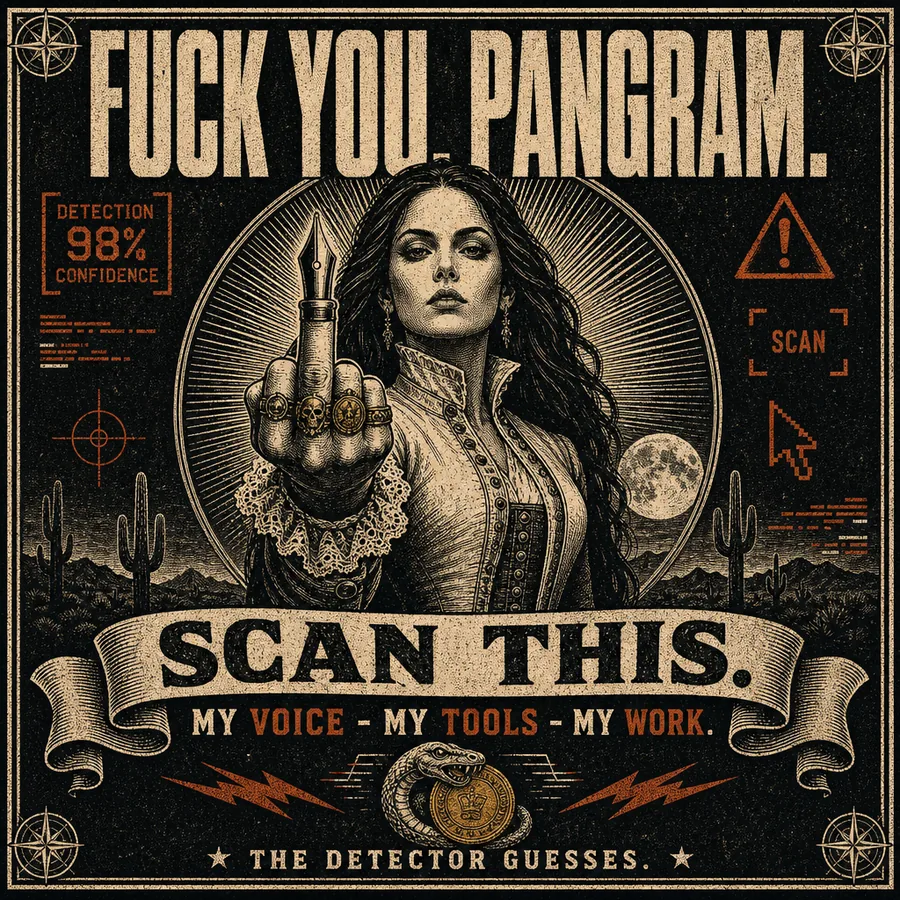
Pangram might be able to determine how much of an article's output is AI generated. Might. I have not found it to be very accurate. But accuracy is the smaller problem. Even a perfect detector, one that never missed and never falsely accused, could only ever tell you which words a model produced. It will never be able to tell how much of the input to the article was human thought.
And none of that input leaves a fingerprint in the prose, because all of it happens upstream of the prose. Who decided the character's wound was abandonment rather than betrayal. Who threw out the four drafts that did not clear the bar. Who built the standards document out of a year of caught failures so the same mistake could never ship twice. Who read the finished thing and put their name on it. A scanner reads the output; the authorship is in the pipeline. I have argued this at length in I Decide What Ships and What “No Human Thought” Implies.
It is also worth asking what a detector is really detecting. The model was trained on millions of pages of human writing. It does not reproduce that corpus; it reproduces its centre of mass, the likeliest next word, over and over. So what gets flagged is not the presence of a machine. It is prose sitting close to the statistical middle of published English. That is a property, not an authorship claim, and a great deal of human writing has it: careful writers, writers working in a second language, genre writers inside established conventions. Anyone who learned to write cleanly.
And slop has been around a great deal longer than AI. Content farms, SEO filler, churned-out copy, going-through-the-motions prose of every description. None of it needed a language model, and slop is what people are actually objecting to. AI made it cheaper to produce. It did not invent it and it does not hold a monopoly on it. A scanner measuring distance from the middle is being asked to return a verdict on effort, and those are not the same measurement.
Which is the joke of it, for a system built like this one. Every gate in my standards document exists to shove the prose away from that middle: no borrowed constructions, no comfortable phrasings, specificity over generic darkness. The scanner and I are measuring the same axis. We disagree about which direction is good.
It is ironic that using a Large Language Model (LLM) to produce Language is considered a sin. Language is literally part of the name.
And then there is the irony sitting at the bottom of the whole thing. Pangram is itself an AI. A classifier, trained on a corpus, returning a probability. The same machinery, doing the same kind of guessing, with the same capacity to be confidently wrong. The people most hostile to machine-generated text have installed a machine as the judge of it, and they accept its verdict without audit and without appeal.
They will not trust an AI to help write a paragraph, and they will trust one to decide whether you wrote yours.
Until such time as they exorcise the Pangram demon, I see no reason to post any articles of my own there.
The other two sites
The systems writing lives at Architecting the Writing Room. That one is a build log and it does read forward: databases, schemas, quality gates, and the standards that keep an AI writing in one voice.
The fiction lives at the author site: Vampires of Tucson, Sonoran Gothic, and everything the essays here keep circling back to.